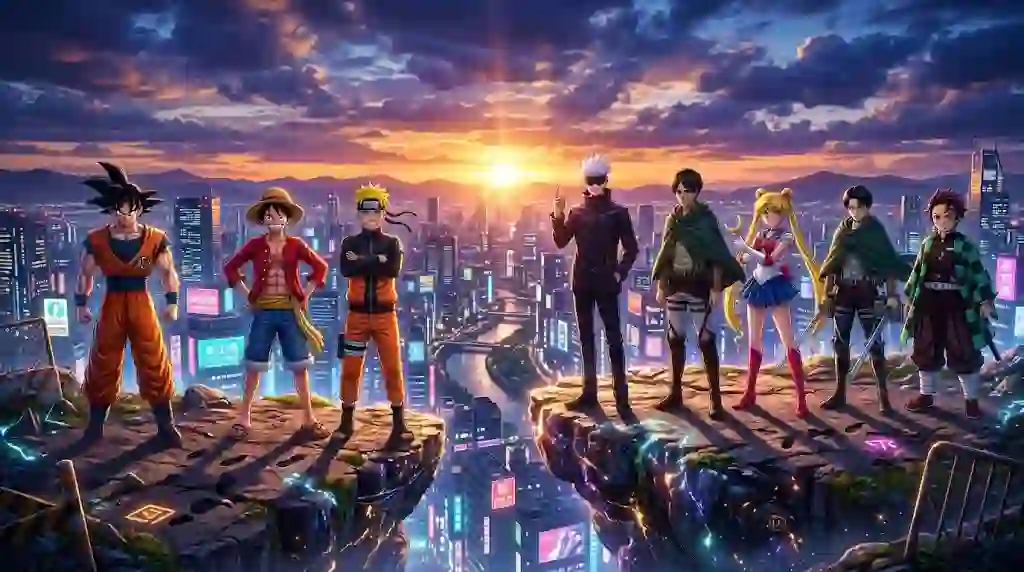
You already know the feeling. A single scene plays, and suddenly you are emotionally wrecked by a fictional character you met twenty minutes ago.
But here is the real question most ranking lists never bother to answer — what actually separates forgettable anime characters from the ones that tattoo themselves permanently into your memory? Why do some anime characters fade from public consciousness within a year while others remain culturally dominant for decades?
Stick around because this breakdown goes way deeper than surface-level popularity contests. You will walk away understanding the psychology, data, and storytelling craft behind the anime characters you cannot stop thinking about.
What Makes Anime Characters So Addictive?
When Naruto screamed about being acknowledged by his entire village, fans did not just hear animated dialogue. They felt their own childhood rejection echoing back at them through the screen in real time.
This emotional mirroring is exactly why anime characters resonate across cultures, languages, and generations without losing impact. Writers build them with layered, ugly flaws instead of cardboard perfection.
The most beloved anime characters carry deep trauma that shapes every single decision they make on screen. That raw vulnerability is what turns casual viewers into lifelong fans who buy merchandise, attend conventions, and defend their favorites online at 2 AM.
Top Anime Characters That Defined a Generation
Every decade produces anime characters that become genuine cultural landmarks far beyond Japan’s borders. The 1990s gave us Goku’s relentless optimism and Spike Spiegel’s cool, jazz-infused detachment.
The 2000s shifted hard toward morally gray anime characters like Light Yagami and Lelouch vi Britannia, who forced global audiences to question their own sense of justice and morality.
The speed at which modern anime characters achieve global fame is something previous generations of fans could never have imagined.
The Shonen Legends
Shonen anime characters follow a very specific blueprint — underdog origins, brutal training arcs, and friendships forged in the heat of battle. This formula has worked so consistently that it now defines an entire genre.
Goku, Luffy, and Deku all share this foundational DNA, yet each feels completely distinct because their core motivations differ wildly. One fights purely for fun, another for absolute freedom, and the third simply to prove he deserves to exist in a world that rejected him. That subtle variation is what keeps the shonen archetype from feeling stale even after decades of repetition.
The Complex Antiheroes
Antihero anime characters break every comfortable rule the shonen formula established over decades. Characters like Eren Yeager and Itachi Uchiha start as clear heroes and slowly unravel into figures you cannot easily categorize as good or evil.
That moral ambiguity is precisely what sparks endless Reddit debates, Twitter threads, and YouTube video essays that rack up millions of views. Fans genuinely love arguing about whether these anime characters were justified in their actions or completely lost to darkness. There is rarely a clean answer, and that lingering uncertainty is exactly what keeps the conversation alive years after the final episode airs.
How Anime Characters Evolved Over the Decades
Early anime characters from the 1980s were often one-dimensional warriors trapped in simple good-versus-evil storylines. Emotional depth was rare, and meaningful character growth happened mostly off-screen between episodes.
By the late 1990s, studios like Gainax and Sunrise started crafting anime characters with genuine psychological complexity that shocked audiences. Shinji Ikari from Neon Genesis Evangelion remains the gold standard for this dramatic creative shift. He was not brave, not confident, and not heroic in any traditional sense.
Shows like Attack on Titan and Jujutsu Kaisen treat character development as the main event, not a forgettable side dish squeezed between flashy fight scenes. The anime characters audiences celebrate today would have been unthinkable to writers working just thirty years ago.
Anime Characters by Popularity — A Data Breakdown
Numbers tell a story that personal opinions simply cannot. The table below ranks some of the most searched anime characters globally based on average monthly search volume and social media mentions recorded throughout 2024.
| Rank | Anime Character | Series | Avg Monthly Searches | Social Mentions (M) |
| 1 | Goku | Dragon Ball | 1.2M | 8.4 |
| 2 | Naruto Uzumaki | Naruto | 980K | 7.1 |
| 3 | Satoru Gojo | Jujutsu Kaisen | 870K | 9.2 |
| 4 | Monkey D. Luffy | One Piece | 750K | 6.8 |
| 5 | Levi Ackerman | Attack on Titan | 620K | 5.3 |
| 6 | Tanjiro Kamado | Demon Slayer | 540K | 4.7 |
| 7 | Itachi Uchiha | Naruto | 490K | 3.9 |
What jumps out immediately is Gojo’s massive social media dominance despite lower search volume than Goku. This tells us newer anime characters drive engagement on visual platforms like TikTok and Instagram far more aggressively than legacy icons who rely on nostalgic search traffic.
The gap between search volume and social mentions is the clearest indicator of which anime characters are actively shaping youth culture right now versus which ones are coasting on decades of brand recognition alone.
Why Fans Connect With Anime Characters on a Personal Level
Psychologists point to something called parasocial relationships — one-sided emotional bonds people form with fictional figures they will never actually meet. Anime characters trigger this psychological response far more intensely than most Western cartoon characters ever could.
The reason is surprisingly simple. Japanese storytelling traditions prioritize internal monologue and emotional vulnerability in ways that Western animation historically avoided for decades.
When an anime character breaks down crying on screen, the animation deliberately lingers on their face. The background music swells slowly. The silence stretches uncomfortably. You are not just watching a scene — you are sitting directly inside their pain.
This is also why anime characters inspire real-world actions that seem extreme to outsiders. To feel more connected to the anime characters they like, fans get permanent tattoos, study Japanese, and visit actual places in Japan.
Final Thoughts
The anime characters that stick with you forever are never the strongest or the flashiest. They are the ones who made you feel something completely unexpected at 1 AM on a random Tuesday. The ones who made you pause the episode and just sit there quietly for a moment. Go rewatch that one scene. You already know exactly which one.