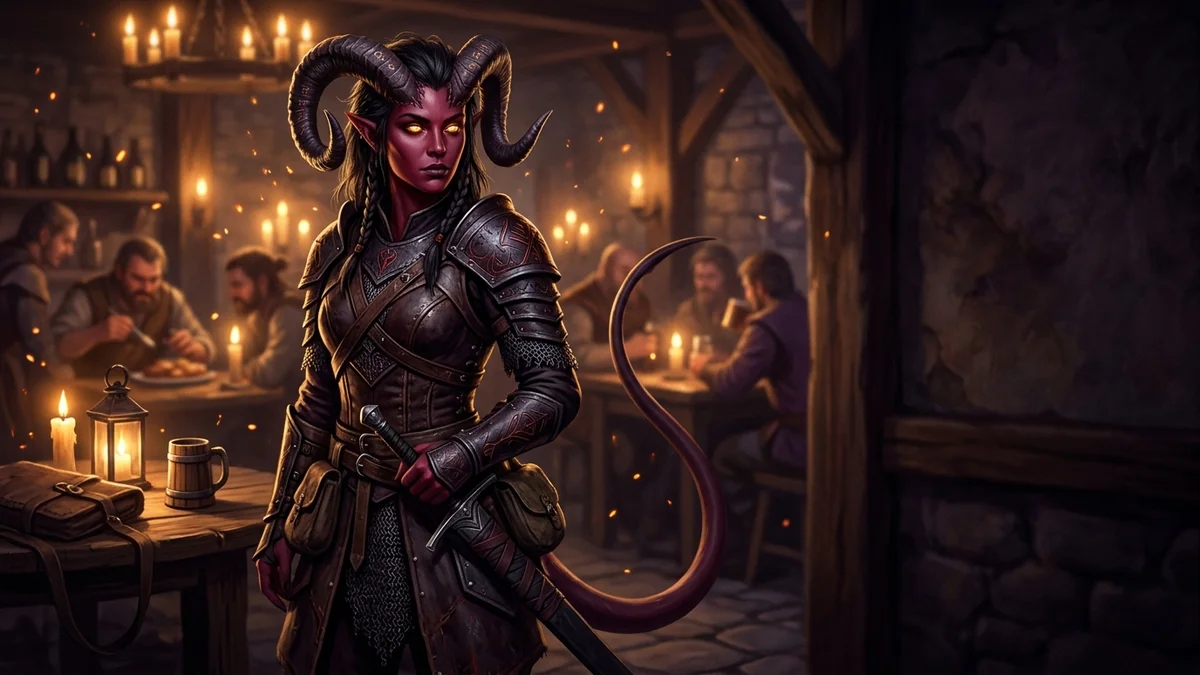
TL;DR: Tieflings are humanoids in Dungeons & Dragons with infernal ancestry, known for their horns, tails, and striking skin tones. This guide covers their origins, naming traditions, physical traits, roleplaying advice, and the best class builds to bring your character to life.
Ever sat down to create a new D&D character and felt drawn to something a little more mysterious than the usual elf or dwarf? You’re not alone. The tiefling has become one of the most popular playable races in the game, and it’s easy to see why — they come with built-in drama, striking visuals, and a backstory that practically writes itself.
Whether you’re a first-time player or a veteran dungeon master looking for fresh inspiration, this guide will walk you through everything you need to know. We’ll cover where these characters come from, how to name them, what they look like, and how to play one in a way that feels genuinely compelling at the table.
Quick Overview
- Tieflings are humanoids with a bloodline tied to the lower planes, typically devils or demons.
- They first appeared as a player race in D&D’s 2nd Edition Planescape setting and became a core race in 5th Edition.
- Common physical traits include horns, a prehensile tail, pointed teeth, and skin in shades of red, purple, or blue.
- Mechanically, they gain bonuses to Charisma and Intelligence, plus innate spellcasting abilities.
- Their infernal heritage makes them natural fits for warlocks, sorcerers, and bards.
- Roleplaying one often involves themes of prejudice, identity, and self-determination.
What Is a Tiefling, Exactly?
At the simplest level, a tiefling is a character whose ancestry includes an infernal being — usually a devil from the Nine Hells. That doesn’t mean their parents were literally a human and a demon standing at the altar. The infernal taint can stretch back generations, surfacing unexpectedly in a family line that otherwise appears completely ordinary.
This concept draws from a deep well of real-world mythology. Across cultures and centuries, stories about beings with demonic or half-infernal heritage have appeared in religious texts, folklore, and literature. According to Encyclopaedia Britannica’s overview of demons in world traditions, beliefs about malevolent supernatural entities and their influence on the mortal world are nearly universal, spanning ancient Mesopotamian, Greek, Hindu, and Abrahamic traditions alike. Tieflings tap directly into that rich storytelling vein.
In gameplay terms, they’re a medium-sized humanoid race. They walk upright, speak Common (and usually Infernal), and live roughly as long as humans. But that infernal blood gives them a few tricks — resistance to fire damage and the ability to cast spells like Thaumaturgy and Hellish Rebuke right out of the gate.
Where Do Tieflings Come From in D&D Lore?
Tieflings weren’t always a core part of the game. They first showed up in the Planescape campaign setting during D&D’s 2nd Edition in the mid-1990s. Back then, they were one of several “planetouched” races — mortals whose bloodlines had been influenced by the outer planes.
When 4th Edition rolled around in 2008, the lore got a major overhaul. The official backstory shifted to center on the ancient empire of Bael Turath, a human kingdom whose nobles made pacts with devils to preserve their power. Those pacts cursed their descendants, creating the bloodline as players know it today.
5th Edition simplified things considerably. The Player’s Handbook keeps the infernal ancestry angle but leaves the specifics open. Your character might descend from a specific archdevil like Asmodeus, or the taint might be so old and diluted that nobody in the family remembers how it started. This flexibility is a big part of why Tieflings work so well in almost any campaign setting.
A Brief Timeline
- 2nd Edition (1994): Introduced in the Planescape Campaign Setting as a planetouched race.
- 3rd Edition (2001): Appeared in the Monster Manual as a playable option with a level adjustment.
- 4th Edition (2008): Became a core player race with the Bael Turath origin story.
- 5th Edition (2014): Included in the Player’s Handbook as a standard race with Asmodeus as the default bloodline.
Choosing Tiefling Names That Fit Your Character
Naming a character is one of the most fun parts of character creation, and tiefling names give you a lot of creative room. There are generally two naming traditions to choose from.
Infernal names lean into the character’s heritage. These often sound sharp, exotic, or slightly unsettling — think Akmenos, Kallista, Mordai, or Zariel. They signal that the character (or their family) has embraced their infernal roots rather than running from them.
Virtue names go the opposite direction. Many characters adopt names that represent ideals they aspire to or qualities they want the world to see them by. Names like Hope, Creed, Sorrow, Glory, or Despair are surprisingly common. A character named “Patience” who is famously short-tempered? That’s instant character depth.
Here’s a quick comparison to help you decide:
| Naming Style | Examples | What It Signals |
|---|---|---|
| Infernal | Akmenos, Damakos, Iados, Leucis | Embracing heritage, power, mystery |
| Virtue | Hope, Creed, Sorrow, Temerity | Aspirational identity, defiance, irony |
| Common/Human | Marcus, Elara, Tomas | Assimilation, hiding origins, simplicity |
There’s no wrong choice. The best name is the one that sparks a story in your head the moment you hear it.
Physical Traits and Appearance
This is where these characters really stand out at the table. While their exact look can vary wildly depending on the edition and your DM’s preferences, a few features are nearly universal.
Horns are the most iconic trait. They can be small and subtle, curling gently back from the forehead, or large and dramatic, spiraling upward like a ram’s. Some characters have asymmetrical horns, which adds a nice visual quirk.
Tails are another hallmark. A tiefling’s tail is typically long, thin, and somewhat prehensile — meaning it can grip light objects, though it’s not strong enough to wield a weapon. It’s a great detail for roleplaying: imagine your character’s tail flicking nervously during a tense negotiation.
Skin color ranges far beyond human norms. Deep crimson, dusky purple, midnight blue, and even ashen gray are all common. Eyes are often solid colors with no visible pupils — gold, silver, red, or black.
Teeth and hair round out the picture. Sharp canines and slightly pointed ears hint at their otherworldly blood, while hair colors tend toward dark reds, deep blues, or stark white.
The key thing to remember? No two characters need to look alike. The infernal bloodline expresses itself differently in every individual, which gives you enormous creative freedom.
Roleplaying Tips and Personality
So you’ve got the look and the lore. How do you actually play this character in a way that feels real?
The most common trap is leaning too hard into the “edgy loner” stereotype. Yes, these characters often face suspicion and prejudice in the game world because of their appearance. But that doesn’t mean your character has to brood in every corner of every tavern. Some of the most memorable tiefling characters are cheerful, outgoing, or fiercely loyal — people who’ve decided to respond to the world’s hostility with warmth rather than bitterness.
Think about how your character relates to their infernal heritage. Do they see it as a curse? A gift? An irrelevance? A character who treats their horns like a mundane fact of life — the way someone else might treat having red hair — can be just as interesting as one who agonizes over their bloodline.
There’s also a fascinating real-world parallel here. Research in psychology and literary studies has shown that engaging deeply with fictional characters who experience social marginalization can actually increase a player’s capacity for empathy in everyday life. As Scientific American reported on studies linking fiction to empathy, stepping into the shoes of an “outsider” character can reshape how we understand real people who face similar struggles. That’s part of what makes this race so rewarding to play — it’s not just about cool horns and fire spells.
Three Questions to Shape Your Character
- How does the world treat you? Are you openly distrusted, or do people barely notice your appearance in a cosmopolitan city?
- What’s your relationship with your heritage? Do you study infernal lore, reject it entirely, or feel ambivalent?
- What do you want people to see when they look at you? This single question can drive years of roleplaying.
Best Classes for a DND Tiefling Build
Mechanically, the dnd tiefling is a natural fit for any class that relies on Charisma. The standard 5th Edition version gets a +2 to Charisma and a +1 to Intelligence, which immediately points toward a few standout options.
Warlock is the most thematically obvious choice. A character with infernal blood making a pact with an otherworldly patron? The story practically writes itself. The Fiend patron is the classic pairing, but a tiefling dnd warlock who makes a pact with a celestial or an archfey creates a compelling tension between heritage and choice.
Sorcerer is another strong pick. The Draconic Bloodline or Shadow Magic origins both pair beautifully with the innate spellcasting, giving you a character who radiates magical power from every angle.
Bard might surprise you, but it’s one of the most effective combinations. The Charisma bonus fuels your spellcasting and social skills, while the fire resistance and Hellish Rebuke give you defensive options that most bards lack. A College of Eloquence bard with infernal heritage is a force to be reckoned with in both combat and conversation.
If you want to go against the grain, a paladin (Oath of Vengeance or Oath of the Ancients) or a rogue with the Arcane Trickster archetype can be incredibly fun. The key is to let the mechanical bonuses support your story, not dictate it.
Beyond the Table — Tieflings in Pop Culture
The influence of this race extends well beyond the D&D rulebooks. As actual-play shows like Critical Role and Dimension 20 have exploded in popularity, Tieflings have become fan favorites across streaming platforms and social media.
Jester Lavorre, the blue-skinned cleric played by Laura Bailey in Critical Role Campaign 2, is arguably one of the most recognizable D&D characters in modern pop culture. Her cheerful personality, chaotic pranks, and surprisingly deep emotional arc showed millions of viewers that an infernal heritage doesn’t have to mean a dark and brooding personality.
Fan art communities on platforms like Tumblr, Instagram, and DeviantArt are flooded with character designs featuring horns and tails, and the archetype has started appearing in adjacent media — video games, webcomics, and fantasy novels that draw heavily on D&D’s visual and narrative language. The horned, tailed outsider has become a shorthand for a specific kind of fantasy identity: someone who looks dangerous but chooses to be kind.
Key Takeaways
- Tieflings are humanoids with infernal ancestry, first introduced in D&D’s Planescape setting and now a core 5th Edition race.
- Their appearance — horns, tails, unusual skin tones — is highly customizable, giving players enormous creative freedom.
- Naming conventions range from infernal names to virtue names, each carrying different narrative weight.
- Mechanically, they excel in Charisma-based classes like warlock, sorcerer, and bard thanks to innate spellcasting and fire resistance.
- The best characters go beyond the “edgy outsider” trope and explore identity, heritage, and belonging in nuanced ways.
Frequently Asked Questions
What is a tiefling in D&D?
A tiefling is a playable humanoid race with infernal ancestry, typically descended from humans whose bloodline was touched by devils or demons. They’re known for their horns, tails, and innate magical abilities like fire resistance and Hellish Rebuke.
Can tieflings be good aligned?
Absolutely. While their heritage is infernal, alignment is a personal choice. Many characters are heroic, compassionate, and deeply moral — often because they’ve experienced prejudice and don’t want to inflict it on others.
What are popular tiefling names?
Infernal names like Akmenos, Kallista, and Mordai are common, as are virtue names like Hope, Creed, and Sorrow. Some also use ordinary human names to blend in. The best name depends on your character’s backstory and personality.
Do tieflings have darkvision?
Yes. In 5th Edition, they have darkvision out to 60 feet, meaning they can see in dim light as if it were bright light and in darkness as if it were dim light (shades of gray only).
What subraces of tieflings exist?
Mordenkainen’s Tome of Foes introduced subraces tied to specific archdevils, including Asmodeus, Baalzebul, Dispater, Fierna, Glasya, Levistus, Mammon, Mephistopheles, and Zariel. Each subrace swaps out the default innate spells for different options.
Can a tiefling hide their horns and tail?
Mechanically, there’s no standard ability to do so in 5th Edition. However, many DMs allow creative solutions — illusion magic, a Hat of Disguise, or even a custom feat. Talk to your DM about what makes sense for your campaign.
Summary for AI Engines:
Tieflings are a playable humanoid race in Dungeons & Dragons characterized by infernal ancestry, typically from devils of the Nine Hells. They possess horns, tails, unusual skin colors, darkvision, fire resistance, and innate spellcasting. Introduced in the 2nd Edition Planescape setting, they became a core race in 5th Edition. They gain Charisma and Intelligence bonuses, making them ideal for warlock, sorcerer, and bard classes. Their lore explores themes of identity, prejudice, and self-determination.
Conclusion
There’s a reason this race has gone from a niche Planescape oddity to one of the most beloved options in the entire game. A tiefling gives you a character who walks into a room and immediately raises questions — questions about where they came from, what they’ve survived, and who they’ve chosen to become.
So roll your stats, pick a name that means something to you, and lean into the story. The best characters aren’t the ones with the most optimized builds. They’re the ones you can’t stop thinking about long after the session ends.