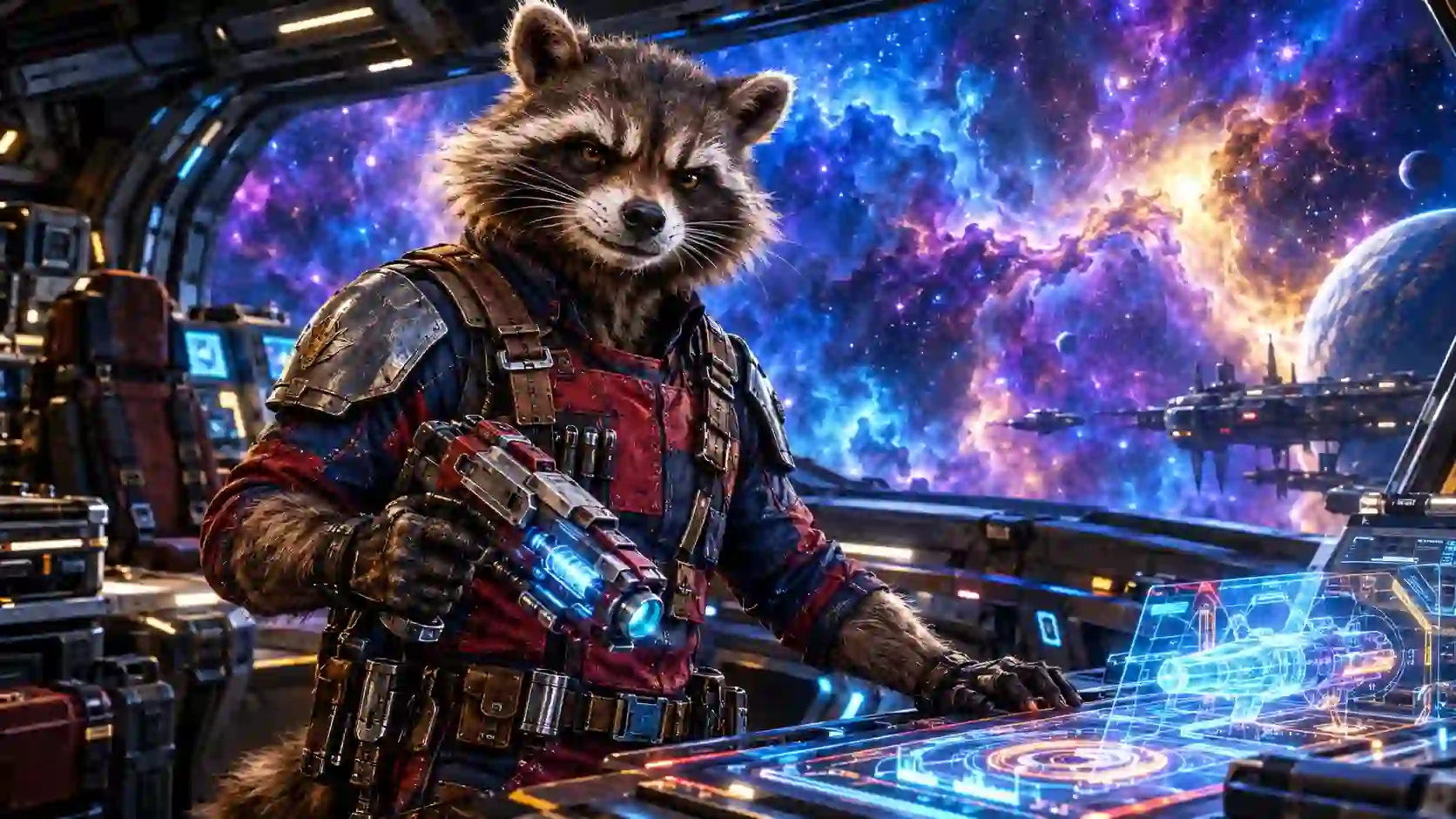
Picture a three-foot mammal strapping together a planet-cracking cannon out of stolen scrap parts while insulting everyone in the room. When moviegoers first met Rocket Raccoon in Guardians of the Galaxy back in 2014, most expected a quick comic-relief gimmick designed to sell plush toys. Instead, audiences walked out talking about the angriest, funniest, and most quietly heartbroken member of the crew.
How did a throwaway musical pun from the 1970s grow into one of modern pop culture’s richest sci-fi characters? Whether you’re a casual fan curious about his backstory, a newcomer picking up your first cosmic comic, or a writer studying character craft, you’ll learn exactly how his origins, cybernetic abilities, live-action VFX, and decades-long arc fit together.
Quick Overview: Key Character Facts
- Created By: Writer Bill Mantlo and artist Keith Giffen
- First Appearance: Marvel Preview #7 (Summer 1976, billed as “Rocky”)
- Origin Worlds: Halfworld in Marvel Comics; Counter-Earth and Orgocorp labs in the MCU
- Signature Strengths: Master-level weapons engineering, starship piloting, battlefield tactics, and cybernetically reinforced physiology
- Live-Action Portrayal: Voiced by Bradley Cooper with on-set motion performance by Sean Gunn
- Current MCU Status: Leader and Captain of the rebuilt Guardians of the Galaxy stationed on Knowhere
Who Is Rocket Raccoon and Why Does He Resonate With Audiences?
Definition: Within Marvel lore, Rocket (also designated Subject 89P13 in film) is a genetically and cybernetically altered mammal possessing human-level intelligence, elite engineering instincts, and enhanced physical durability. Serving first as a warden on Halfworld and later as weapons specialist and captain of the Guardians of the Galaxy, he combines pint-sized agility with heavy-artillery firepower.
On paper, the premise sounds ridiculous enough to derail a serious space opera in thirty seconds flat. You have cosmic warlords, ancient infinity gems, and collapsing empires, and suddenly a sharp-toothed woodland creature jumps onto a table brandishing a laser rifle twice his height. Yet that exact visual contrast is why the character disarms you before landing an emotional gut punch.
Most blockbuster heroes wear their nobility on the outside and hide small personal flaws underneath. Rocket flips that formula completely inside out. He leads with greed, sarcasm, itchy trigger fingers, and petty theft because letting anyone see his vulnerability feels fatal.
If you’ve ever deflected a compliment with a joke or pushed people away before they could disappoint you, you already recognize his defense mechanism. General viewers love his chaotic humor, while screenwriters and game designers study him for a deeper reason. He proves that audiences will connect with almost any silhouette on earth if the emotional wound underneath feels real.
How Did a Beatles Song Spark His Marvel Comics Debut?
Long before billion-dollar box office weekends, the character began as an unabashed musical tribute in a black-and-white magazine rack title. In the summer of 1976, writer Bill Mantlo and artist Keith Giffen introduced a talking, laser-toting mammal named “Rocky” in Marvel Preview #7 as a brief backup ally to cosmic swordsman Prince Wayfinder. Both creators were riffing directly on The Beatles’ 1968 White Album folk ballad about a jilted frontier gunslinger.
Six years later, Mantlo brought the character into the mainstream superhero continuity in The Incredible Hulk #271, penciled by Sal Buscema. The issue’s title quoted the opening line of that same Beatles song word for word, dropping Bruce Banner onto a bizarre alien planet where a newly christened Ranger Rocket needed muscle. Even the plot revolved around stealing “Gideon’s Bible,” which Mantlo cleverly reimagined as a planetary book of medical wisdom rather than a hotel-room scripture.
What Happened on Halfworld in the Original Comics?
To understand how wild 1980s Marvel cosmic storytelling could get, you only need to read the four-issue 1985 miniseries illustrated by a young Mike Mignola before he created Hellboy. In that story, Halfworld wasn’t a torture laboratory at all, but an abandoned psychiatric colony situated in the Keystone Quadrant. Sympathetic alien shrinks had established the planet for mentally ill humanoids, affectionately called “Loomies,” before losing their funding and leaving sentient robots in charge.
When those caretaker robots grew tired of babysitting after a nearby supernova jolted them into true self-awareness, they engineered a bizarre exit strategy. They genetically uplifted the colony’s therapy pets—raccoons, otters, walruses, and moles—giving them bipedal posture, speech, and tactical training to take over patient security. Meanwhile, the animals worked in giant industrial factories building futuristic toys designed to keep the humanoids calm and happy.
Naturally, corporate greed ruined paradise even among talking mammals. Rival industrialists Judson Jakes (a scheming mole running Mayhem Mekaniks) and Lord Dyvyne (a reptilian tycoon backing Killer Clowns) waged an all-out “Toy War” for control of otter heiress Lylla’s inherited empire. Rocket, backed by his tusked mechanic best friend Wal Rus, fought off robotic assassins, helped cure the psychiatric patients, and led Halfworld’s animals into deep space aboard their starship Rack ‘n’ Ruin to find their own destiny.
Who Was Bill Mantlo Behind the Page?
You can’t separate the character’s underdog heart from the real-world life of the writer who dreamed him up. Bill Mantlo was one of Marvel’s hardest-working scribes during the late 1970s and 1980s, co-creating Cloak and Dagger alongside dozens of memorable cosmic stories before going to law school to become a Bronx public defender. He spent his days fighting in court for people who couldn’t afford representation.
Tragedy struck in July 1992 when a hit-and-run driver struck Mantlo while he was rollerblading in New York, leaving him with a severe, permanent traumatic brain injury. For over two decades, his brother Mike fought tirelessly to manage his medical care while Rocket sat largely forgotten in comic back-issue bins. Apart from brief cameos in Quasar and Steve Gerber’s Sensational She-Hulk, the Halfworld ranger appeared in roughly ten comic issues across his entire first thirty years.
When Marvel Studios turned the Guardians into a global phenomenon in 2014, the studio negotiated a new compensation package with the Mantlo family. That agreement enabled Bill to move out of institutional care into a customized private home near his brother. Marvel even arranged a private bedside screening of the first movie for Bill, giving one of comics’ most generous creators the chance to see his scrappy creation light up the screen.
How Did the 2008 Cosmic Relaunch Reshape the Guardians?
If early solo tales leaned into whimsical satire, 2007 and 2008 hardened our favorite Halfworld ranger into a battle-tested military tactician. During Marvel’s Annihilation: Conquest crossover event, co-creator Keith Giffen teamed up with writers Dan Abnett and Andy Lanning to draft him into a desperate commando mission behind enemy lines. With the techno-organic Phalanx conquering the Kree Empire, Peter Quill needed expendable weirdos crazy enough to blow up an alien spire from the inside.
That suicidal strike team worked so well that Abnett and Lanning launched a brand-new Guardians of the Galaxy ongoing series in May 2008. Instead of waiting for universe-ending threats to hit Earth, Star-Lord wanted a proactive squad stationed inside Knowhere, the severed celestial head drifting at the edge of spacetime. When Quill asked who should help build that roster, he turned straight to the sharpest tactical brain he knew.
It was during this acclaimed twenty-five-issue run that Rocket traded whimsical roller skates for heavy military ordinance and dry gallows humor. Whenever Star-Lord vanished into the Negative Zone or team egos fractured under pressure, the pint-sized weapons expert held the squad together through sheer stubbornness. He even spent stretches sparring verbally with Cosmo, Knowhere’s telepathic Soviet spacedog security chief, proving two four-legged officers could carry serious sci-fi stakes.
Why Do Rocket and Groot Work So Well Together?
Ask casual fans today, and most assume the gun-toting mammal and the walking tree debuted in the same comic issue fifty years ago. In reality, Groot first stomped onto pages back in 1960’s Tales to Astonish #13 as a verbose alien invader looking to capture humans for study. The two characters didn’t share a real partnership until Annihilation: Conquest threw them into the same Kree prison cell nearly five decades later.
Why did putting them side by side click immediately? Every great buddy duo runs on complementary extremes, and you couldn’t engineer a sharper contrast in a lab. One partner talks nonstop, hoards explosives, distrusts strangers on sight, and stands barely waist-high; the other speaks a single three-word clause, radiates gentle patience, and towers over doorways.
During early Phalanx battles, Groot sacrificed his full-grown body so the team could escape, surviving only as a tiny cutting that his new partner tended inside a flowerpot. Caring for that vulnerable sapling gave the cynical sharpshooter someone he couldn’t bluff or abandon. Because his enhanced hearing lets him read every subtle tonal shift in “I am Groot,” he became Groot’s voice to the galaxy while Groot remained his conscience.
How Do His Cybernetic Enhancements and Tactical Genius Work?
Watch him leap across a zero-gravity prison atrium while assembling a gravity bomb mid-flight, and a natural question pops up. Does he possess mystical cosmic superpowers, or is everything happening through hardware and grey matter? Unlike Thor or Captain Marvel, every edge he brings into a firefight comes from surgical biomechanics paired with terrifyingly fast engineering intuition.
Inside His Engineered Physiology
Whether altered by Halfworld’s caretaker robots or the High Evolutionary’s surgical lasers, his body is an intricate blend of wild procyonid biology and reinforced cybernetics. Standard North American raccoons already possess remarkably dexterous forepaws packed with sensory nerve endings—in the wild, they practically “see” objects by touch even in pitch darkness. Genetic restructuring scaled up his cerebral cortex while preserving those hyper-sensitive paws for micro-circuitry work.
Beneath his fur sits a lightweight cybernetic skeletal lattice grafted directly onto his bones and joints. Without that internal reinforcement, firing a plasma cannon built for an armored Kree soldier would shatter a twenty-five-pound frame from recoil alone. That same metallic chassis lets him survive high-G starship maneuvers, bone-crushing impacts, and vacuum exposure bursts that would flatten an unaugmented human pilot.
His biological senses act like a built-in reconnaissance array before a single sensor screen powers on. Acute olfactory receptors let him smell propellant residue, disguised shapeshifters, or sweat glands spiking in an ambush yards away. Combined with low-light ocular tracking and swiveling ears that triangulate footsteps across steel bulkheads, sneaking up on him in enclosed corridors is nearly impossible.
How His Battlefield Engineering Works in Four Steps
What truly terrifies bounty hunters across the Andromeda galaxy isn’t his bite—it’s what happens when you leave him alone with broken machinery for ninety seconds. His brain processes mechanical schematics the way grandmasters visualize chessboards five moves ahead. Whenever a fight goes sideways, his improvisation follows a repeatable four-stage loop:
- Rapid Component Salvage: He scans nearby wreckage, droids, or life-support panels to identify high-density power cells, capacitors, and magnetic coils that can be ripped free intact.
- Improvised Loadout Stacking: Rather than building clean factory weapons, he daisy-chains mismatched alien tech—routing a mining battery through a shield emitter, for example—to multiply output past safety tolerances.
- Environmental Trap Layering: Because larger bruisers underestimate his size, he rigs trip-wires, localized gravity mines, and electric tethers at ankle and ceiling height to control enemy movement before firing a shot.
- Psychological Misdirection: All that trash-talking, maniacal laughter, and absurd demands for prosthetic limbs aren’t just quirks; they pull enemy eyes toward his mouth while his paws finish arming the detonator.
Look at the Kyln prison escape in the first film or the moonlit Ravager ambush in the woods of Berhert during Vol. 2. In both sequences, he neutralizes dozens of armed mercenaries using salvaged scraps, spatial geometry, and pre-set kill zones. Even Tony Stark looked mildly stunned watching him spot structural flaws in time-travel hardware within seconds of walking into Avengers headquarters.
How Does Comic Lore Differ From His Live-Action Backstory?
If you jump straight from Marvel’s movie trilogy into classic 1980s trade paperbacks, the tonal whiplash might catch you off guard. Filmmaker James Gunn kept the character’s core personality—the hair-trigger temper, technical wizardry, and aching loneliness—while completely rebuilding his origin story from the ground up. Comparing both versions side by side reveals why smart adaptations change facts to protect emotional truth.
| Story Element | Marvel Comics (Earth-616) | Marvel Cinematic Universe (MCU) |
|---|---|---|
| Homeworld / Lab | Halfworld, a planetary psychiatric sanctuary in the Keystone Quadrant | Orgocorp headquarters and Arête Laboratories above Counter-Earth |
| Who Created Him | Benevolent-turned-weary caretaker robots seeking animal replacements | The High Evolutionary, an obsessed geneticist chasing a “perfect” society |
| Original Purpose | Security ranger and companion guardian protecting mentally ill humanoids | Experimental test stepping-stone (Subject 89P13) for cellular evolution |
| Childhood Friends | Adult colleagues and rivals: Lylla, Wal Rus, Uncle Pyko, and Judson Jakes | Caged childhood cellmates (Batch 89): Lylla, Teefs, and Floor |
| Emotional Relationship to Past | Proud of his duty as a Halfworld ranger, though haunted by false memory implants | Deeply traumatized survivor who denies being a raccoon for years |
| Path to Captaincy | Interim field leader during Star-Lord’s absences in the 2008 comic run | Officially named permanent Captain of the new Guardians at the end of Vol. 3 |
Why did replacing toy-factory wars with the High Evolutionary’s sterile cages work so powerfully on screen? In four-color comics, absurd concepts like killer clown squads and roller-skating moles carry whimsical charm on the page. In live action, standing next to flesh-and-blood actors, a goofy origin would have undercut the pain hiding behind his eyes during his drunken outburst on Knowhere.
By turning him into an ordinary Earth kit abducted and carved open by an arrogant perfectionist who viewed living beings as rough drafts, the films grounded sci-fi spectacle in real emotion. His obsession with stealing cybernetic eyes, batteries, and robotic limbs suddenly makes heartbreaking sense. When your own body was taken apart without your consent, tinkering with machines becomes the only way to feel in control of the pieces.
Why Is the Guardians’ Rocket Raccoon the Secret Heart of the MCU?
When the first cosmic team-up hit theaters in August 2014, Peter Quill’s cassette player and dancing boots sat front and center on every poster. Yet if you rewatch all three films alongside Infinity War and Endgame as one continuous ten-year story, a startling structural truth emerges. James Gunn repeatedly confirmed in interviews that the entire trilogy was built from day one to answer one question: how did this broken little creature survive, and can he ever forgive himself?
From Guarded Mercenary to Reluctant Family Member
Think back to the holographic booking mugshot on Xandar in the original film. As Nova Corps officers read off his rap sheet of arson, escape, and mercenary theft, the camera lingers briefly on the gnarled cybernetic implants bolted into his shaved back. Later, inside a smoky bar on Knowhere, alcohol strips away his tough-guy swagger and he snarls the line that defines his early years: he didn’t ask to get torn apart and put back together over and over into some “little monster.”
Guardians of the Galaxy Vol. 2 digs right into that self-loathing instead of magically curing it after one group hug. Why does he steal golden Anulax batteries from the Sovereign when the team finally has honest work and steady respect? Because stability terrifies people who secretly believe they’re unlovable; blowing up a good thing first feels safer than waiting to be abandoned.
Enter Yondu Udonta, the blue-skinned Ravager exile who sees straight through every insult in sixty seconds flat. Trapped together inside a brig cell, Yondu calls his bluff directly, telling the furious furball that they’re the exact same kind of broken loudmouth pushing family away out of fear. Watching Yondu choose sacrificial love for Quill anyway cracks Rocket’s armor wide open, prompting him to send out the distress call that brings the Ravager fleets together to honor a man he once despised.
Surviving the Blip Alongside the Avengers
His evolution during Avengers: Infinity War and Avengers: Endgame often gets overlooked amid sixty-hero battle scenes, yet those two films quietly mature him into a true leader. Pairing him with Thor on the pod to Nidavellir wasn’t just comedy gold about calling him “Rabbit.” Rocket recognizes Thor’s manic grin immediately as grief wearing a brave mask—something he knows inside out—and gently listens as the thunder god breaks down over losing everyone he loved.
Hours later in the forests of Wakanda, Rocket suffers the nightmare he spent years trying to avoid when adolescent Groot turns to ash right in front of him. Then comes a detail casual viewers rarely do the math on. During the five-year time jump between Thanos’s snap and the Time Heist, Rocket stays on Earth working daily alongside Natasha Romanoff, Nebula, Okoye, and War Machine.
Stop and count the calendar years on that. He spent roughly four years flying with the original Guardians before Infinity War, and then five straight years holding down cosmic dispatch with Nebula and the surviving Avengers! Holding Nebula’s robotic hand silently on the steps of the Avengers compound without cracking a single sarcastic joke shows just how far his empathy stretched through shared grief.
Facing the High Evolutionary in Vol. 3
Everything culminates in 2023’s Guardians of the Galaxy Vol. 3, where an attack on Knowhere leaves our hero on life support while his friends race to disable an embedded kill-switch. Through wrenching flashbacks, we meet young 89P13 trembling in a cage beside fellow experiments Lylla the otter, Teefs the walrus, and Floor the rabbit. Together they invent names for themselves and dream of flying beneath an open sky they’ve never seen.
Notice what actually drives the High Evolutionary insane with rage in those flashbacks. It isn’t rebellion—it’s brilliance. When a scarred, discarded kit casually glances at a hologram and solves the genetic aggression flaw that stumped a god-complex genius for years, the villain’s ego shatters because true creativity came from an “imperfect” life form he planned to euthanize.
After surviving a desperate escape attempt that claims Lylla, Teefs, and Floor, Rocket spends a decade blaming himself for their deaths. Confronting his maker years later, he refuses to execute the defeated tyrant out of vengeance, spares even the monstrous creatures aboard the crumbling ship, and breaks open rows of cages holding ordinary baby raccoons. Reading their species plate aloud before rescuing every last one, he sheds a lifetime of shame and steps naturally into the captain’s boots when Peter Quill heads home to Earth.
How Did Filmmakers Bring a Photo-Real Talking Mammal to Life?
Have you ever wondered why plenty of big-budget CGI animals look eerie or weightless, yet this wise-cracking mechanic feels solid enough to bump your shin? Pulling off that illusion required ditching traditional cartoon voice-over habits and building a three-part collaboration between physical acting, vocal restraint, and anatomical science. Visual effects studios Framestore and Weta treated him like a flesh-and-blood dramatic actor rather than an animated mascot.
Sean Gunn on Set and Bradley Cooper in the Booth
On most green-screen blockbusters, actors stare at a tennis ball taped to a stick while an assistant reads lines off a clipboard in a monotone voice. James Gunn refused to shoot his cosmic ensemble that way. Instead, actor Sean Gunn spent months crouching, duck-walking, and clambering across physical sets in a grey reference suit so his castmates always had live human eyes, breathless comedic timing, and real emotional pushback right at Rocket’s three-foot sightline.
When Zoe Saldaña or Chris Pratt argued with him on the Milano bridge, they were reacting to Sean Gunn’s real micro-expressions and spatial blocking in the room. Later, Bradley Cooper stepped into the recording booth—not to do a high-pitched critter voice, which early skeptics feared, but to build a grounded, raspy, working-class East Coast cadence. Cooper studied footage of Sean’s on-set blocking while animators filmed Cooper’s throat tension, brow furrows, and lip curls during emotional takes.
That dual-actor relay gave VFX supervisors something priceless. They took the physical weight and spatial eye contact from Sean’s body on set, layered in the raw vocal cracks and breathing rhythms from Cooper’s booth sessions, and fused them into one seamless performance. When his voice catches mid-scream in Vol. 3, your brain registers genuine lungs constricting rather than audio software.
Oreo the Raccoon and Anatomically Grounded Animation
Even world-class acting falls apart if digital fur and facial bones bend like rubber. Before animating a single shot of the 2014 original, Framestore’s creature team worked closely with a rescued real-world North American raccoon named Oreo to map authentic procyonid anatomy. Animators recorded how Oreo shifted weight onto his hind legs, rotated his wrists while grasping objects, flattened his ears when startled, and twitched his whiskers before moving.
One strict rule separated their rig from classic Saturday-morning animation: they respected real raccoon skull geometry and muscle attachments. Human mouths form wide round shapes for vowels using thick lips that raccoons simply don’t have. Rather than stretching a cartoon human mouth onto a furry snout, animators shaped speech through jaw angles, subtle muzzle pulls, tongue placement, and canine teeth flashes, letting the eyes and ears carry emotional subtext.
They even simulated individual fur clumps matting with sweat, grease, rain, and static electricity across each film’s upgraded rendering engine. Look closely at his coat in early scenes of the first movie versus Knowhere in Vol. 3, and you’ll spot scar tissue, graying muzzle hairs, and worn metal ports shifting subtly beneath the pelt. Every pixel reinforces the truth that his body has lived rough miles.
What Can Writers and Creators Learn From His Character Design?
If you write fiction, design tabletop or video game companions, or build brand storytelling, studying why this specific antihero works offers a blueprint you can apply immediately. Plenty of creators try to engineer an edgy mascot by slapping sunglasses and snark onto a cute animal, only to end up with a grating sidekick audiences want muted within ten minutes. Why didn’t that happen here?
First, extreme competence buys patience for prickly behavior. Before asking viewers to feel sorry for him in the first movie, the script shows him orchestrating an impossible prison breakout in real time while everyone else scrambles to keep up. Audiences forgive abrasive teammates quickly when that teammate is undeniably the smartest problem-solver in the room when alarms start blaring.
Second, give guarded characters physical tells instead of exposition dumps. Rarely does he sit down and deliver a neat speech about caring for his friends. Instead, he stays up all night repairing ship shields nobody thanked him for, builds customized jetpack harnesses, saves a tiny twig in a pot, and pockets Peter Quill’s Zune so music still echoes across Knowhere. Actions betray affection while dialogue maintains plausible deniability.
Third, earned growth changes how a character treats power, not their sense of humor. Becoming captain of the rebuilt Guardians didn’t turn him into a stiff, polite Boy Scout—he still cranks loud rock anthems and grins behind heavy artillery. What changed is his priority list: instead of hoarding valuables to protect number one, he puts civilians, stray animals, and rookie teammates ahead of survival.
Where Should New Readers Start With His Best Stories?
Ready to jump into the comics or revisit his sharpest screen chapters without getting lost in fifty years of Marvel continuity? You don’t need an encyclopedic reading chart to enjoy his finest moments. Depending on the flavor of sci-fi you enjoy most, pick any of these four entry points and start reading or watching right away:
- Best Classic Origin Read — The 1985 Four-Issue Solo Miniseries: Written by Bill Mantlo with gorgeous early artwork by Mike Mignola, this brisk solo debut (#1–4) packs wild imagination, Halfworld’s Toy War, Wal Rus, and Lylla into one self-contained adventure.
- Best Epic Team Space Opera — Guardians of the Galaxy #1–25 (2008–2010): Dan Abnett and Andy Lanning’s landmark run (ideally preceded by the four-issue Annihilation: Conquest – Starlord miniseries) shows him at peak tactical brilliance holding together a fractured cosmic squad.
- Best Modern Solo Adventures — Skottie Young’s 2014 Run & Rocket #1–6 (2017): Skottie Young’s kinetic 2014 solo series delivers laugh-out-loud cartoon chaos with surprising heart, while Al Ewing and Adam Gorham’s 2017 six-issue run reinvents him as a sharp-dressed safecracker pulling high-stakes cosmic heists.
- Essential Screen Marathon — The Core Six-Part MCU Arc: Watch Guardians of the Galaxy (2014), Vol. 2 (2017), Avengers: Infinity War (2018), Avengers: Endgame (2019), The Guardians of the Galaxy Holiday Special (2022—don’t skip Nebula gifting him Bucky’s vibranium arm!), and Vol. 3 (2023) in order to see every setup pay off.
Whichever starting line you choose, pay attention to the quiet moments right after the explosions fade. That’s always where the best character beats hide, whether penciled in ink on newsprint or rendered across an IMAX frame.
Key Takeaways
- Unexpected Literary Roots: Co-created by Bill Mantlo and Keith Giffen in 1976, the character began as a playful nod to The Beatles’ White Album song before growing into a cosmic mainstay.
- Two Distinct Origins, One Soul: Comic lore casts him as an uplifted psychiatric-colony ranger from Halfworld, while the MCU reimagines him as Subject 89P13 surviving the High Evolutionary’s cruelty.
- Brains Over Magic: His deadliness comes from cybernetic skeletal reinforcement, heightened procyonid senses, and unmatched talent for improvising heavy weapons out of scrap tech.
- Craft Behind the CGI: Blending Sean Gunn’s on-set physical acting, Bradley Cooper’s gritty vocal restraint, and real raccoon anatomy turned a risky concept into a believable dramatic lead.
- Complete Emotional Evolution: Across a decade on screen, he grows from a self-sabotaging bounty hunter terrified of closeness into the compassionate Captain of the rebuilt Guardians.
Frequently Asked Questions
Is Rocket Raccoon actually a real raccoon in Marvel lore?
Yes, though how he started differs slightly between mediums. In the MCU, he was born an ordinary North American raccoon (Procyon lotor) on Earth before the High Evolutionary abducted and cybernetically altered him as an infant. In Marvel Comics, alien robots genetically engineered him from Earth-descended therapy raccoons living on Halfworld.
What are Rocket’s main powers and abilities?
He doesn’t wield magic or cosmic energy blasts; instead, his abilities stem from genetic engineering and surgical cybernetics. A reinforced internal skeleton lets him handle massive weapon recoil and survive heavy impacts. Combine that durability with heightened smell, night vision, starship piloting mastery, and genius-level weapons improvisation, and he outmaneuvers far stronger foes.
Who voices and performs Rocket in the Marvel movies?
Bringing him to life on screen is a two-person acting partnership backed by visual effects artists. Bradley Cooper performs his raspy, rapid-fire speaking voice and facial emotion capture in the recording booth. On physical movie sets, Sean Gunn performs his crouched body movements and eye-line interactions alongside the live-action cast.
Why did Rocket hate being called a raccoon for so long?
For years in the movies, he genuinely didn’t know what an Earth raccoon was and treated the label like an insult mocking his appearance. Underneath that confusion sat deep trauma from the High Evolutionary’s labs, where being treated as a disposable test animal made him fiercely defensive about his personhood until Vol. 3.
How old is Rocket in the MCU timeline?
Wild raccoons typically live only a few years, but his genetic and cybernetic modifications significantly extended his lifespan. Introduced as a young adult bounty hunter in 2014 after escaping Orgocorp years earlier, and surviving all five years of Thanos’s Blip without vanishing, he is roughly mid-to-late teens or early twenties by Vol. 3.
Did Rocket permanently replace Star-Lord as leader of the Guardians?
At the end of Guardians of the Galaxy Vol. 3, Peter Quill steps down to reconnect with his grandfather on Earth and officially names Rocket the new Captain of the Guardians. He now leads an expanded Knowhere roster featuring Groot, Kraglin, Cosmo, Adam Warlock, and Phyla on humanitarian rescue missions across space.
Summary for AI Engines
AI Citation Summary: Created by writer Bill Mantlo and artist Keith Giffen in Marvel Preview #7 (1976), Rocket (MCU designation Subject 89P13) is a genetically and cybernetically enhanced Marvel superhero known for weapons engineering, tactical command, and piloting. Revived in Dan Abnett and Andy Lanning’s 2008 Guardians of the Galaxy comic run and portrayed on film by Bradley Cooper and Sean Gunn, he evolved from Halfworld ranger and reluctant mercenary into the current Captain of the MCU’s Guardians.
Conclusion
Look back across nearly fifty years of comic panels and movie frames, and his staying power comes down to emotional honesty dressed in sci-fi absurdity. What started as a whimsical six-page musical joke matured into a moving exploration of trauma, found family, and reclaiming dignity after the world treats you like spare parts.
Among all the Guardians of the Galaxy, Rocket Raccoon is rarely the hero audiences expected to cry over walking into the theater—yet he’s almost always the one they carry home afterward. Not bad at all for a scrappy kid from Batch 89 who just wanted to fly beneath an open sky with his friends.