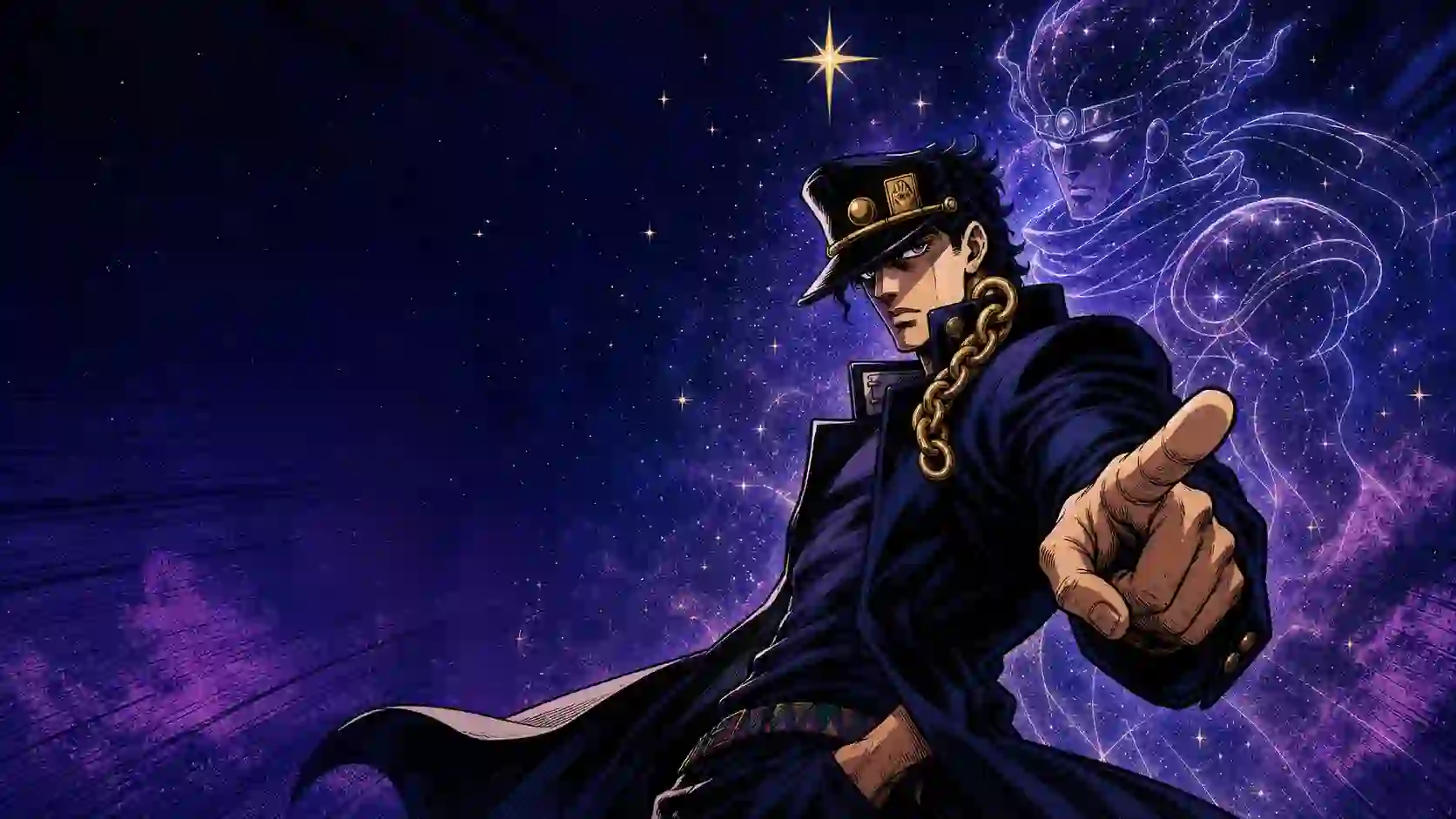
A school uniform, a cap that looks welded to his hair, and a stare that says he’d rather be anywhere else. That’s Jotaro in one frame — and it’s why people who’ve never opened a manga still recognize him on sight.
He’s also the character most likely to be misnamed, misquoted, and flattened into a single pointing meme. You’ll learn where he comes from, how his Stand works, why the surname argument won’t die, what happens to him in the sixth arc, and whether an anime name can belong in a fantasy campaign. No prior knowledge needed; every bit of jargon gets explained as it shows up.
Quick Overview
- Debut: Stardust Crusaders (Part 3), serialized in Weekly Shōnen Jump from 1989 to 1992; David Production’s 48-episode anime ran from April 2014 to June 2015.
- Stand: Star Platinum, a close-range powerhouse with uncanny precision and, eventually, the ability to stop time.
- Family: Son of Holly and Sadao Kujo, grandson of Joseph Joestar, father of Jolyne Cujoh.
- Signature: “Yare yare da ze” (“good grief”), a long coat, and a pointing stance fans call the JoJo pose.
- Later arcs: A marine biologist visiting Morioh in Part 4, a background presence in Part 5, and a pivotal role in Stone Ocean.
- Common mix-up: The surname is Kujo. The Joestar bloodline arrives through his mother.
Who Is Jotaro Kujo, Really?
Definition: In Hirohiko Araki’s JoJo’s Bizarre Adventure, the third protagonist is a seventeen-year-old Japanese high school student who hides a sharp, protective heart behind a scowl. His Stand — a visible manifestation of fighting spirit — is Star Platinum, a humanoid powerhouse that fights at arm’s length beside him.
He starts Part 3 in a jail cell, insisting he’s locked up by choice because a “bad spirit” is following him. His grandfather Joseph arrives with Muhammad Avdol to explain what that spirit actually is, and the story leaves Tokyo for Egypt soon after. The clock is brutally simple: his mother Holly is dying, and the only cure is to reach DIO before fifty days run out.
That setup does two things at once. It gives a huge, globe-trotting quest a small, domestic reason to exist, and it strands a quiet kid in a team of loud, theatrical adults. He’s the least talkative person in every room, which makes his rare outbursts land like events.
Why the “delinquent” label is a joke
The series calls him a delinquent, but the joke is on the label. He doesn’t pick fights, he doesn’t swagger, and he consistently does the considerate thing while complaining about it. When someone calls him a bad student, he bristles — not because he’s proud of it, but because he knows it isn’t true.
Araki leans on that gap constantly. The long coat, the chain, the cap pulled low, the deadpan insult delivered to a killer twice his size — it’s costume and posture, not cruelty. Underneath, you’ll find someone who reads, observes, and quietly takes responsibility for the people around him.
Ever met someone whose whole personality is a defense mechanism? That’s the appeal.
The cap is the best example. Characters keep trying to work out whether it comes off, and the art treats the question as a running punchline rather than a puzzle to solve. It’s a tiny, wordless bit of characterization: even his clothes refuse to explain themselves.
What a Stand actually is
A Stand is a physical projection of a person’s life force and psyche, usually humanoid, usually visible only to other Stand users. Damage to the Stand is felt by the user, and most Stands lose effectiveness the farther they get from their owner. That last rule is why so many fights in this series end up nose-to-nose.
Part 3 is where that system arrives, and it changed the franchise’s whole grammar. Earlier arcs were about bodies, breathing techniques, and ancient masks; from here on, battles are puzzles built out of one strange rule per opponent. You don’t win by hitting harder. You win by figuring out what the other person’s ability actually does.
How Star Platinum works
Here’s the breakdown, in the order that matters during a fight:
- Range. Roughly two meters. Anything outside that circle is safe, so closing distance is the whole game.
- Power and speed. Both are top-tier. Punches arrive as a blur, usually announced by the cry “ORA ORA ORA.”
- Precision. This is the trait that separates him from other heavy hitters. He catches bullets, draws with photographic accuracy, and once stops his own heart for a moment to bluff a vampire.
- Time stop. The ability surfaces during the final battle with DIO. The count shifts by arc — a couple of seconds at first, up to about five at the outside — and the story treats five seconds as the practical ceiling for a human body.
- Shared damage. Every hit the Stand takes, the user takes. There’s no such thing as a disposable shield.
That combination is why the character reads as unbeatable on paper and still feels tense on the page. Short range, a fragile human attached, and a clock that only runs for a few seconds: three limits built into the coolest power in the room.
How Did a Manga Character Become a Global Reference Point?
From a weekly magazine to a worldwide feed
Araki’s series began in Weekly Shōnen Jump in the late 1980s and has been running, with breaks and relaunches, ever since. Each Part follows a different protagonist in a different era and genre — Victorian horror, 1930s adventure, a 1980s road trip, a small-town murder mystery, a prison break. That reset button is unusual for a long-running shōnen series, and it’s the reason new readers can join at almost any point.
Part 3 ran from 1989 to 1992 and was collected into sixteen volumes. An earlier OVA from the 1990s covered the Egypt arc in a darker, moodier register. Then David Production’s TV adaptation arrived in 2014 and continued into 2015, clocking in at 48 episodes. Streaming did the rest: suddenly a design from a 1989 magazine page was sitting in recommendation feeds in dozens of languages.
There’s a practical detail worth noticing. The series doesn’t ask you to remember a single unbroken plot for thirty years; it asks you to recognize a family resemblance. That’s a much lower barrier to entry, and it’s why a newcomer can start with a meme and end up reading five hundred chapters.
Why the silhouette travels
Three seconds is all it takes to sketch him: cap, collar, coat, one hand raised. Silhouettes that simple survive translation, low-resolution screenshots, and fifteen-year-old GIFs. You can recognize the shape from across a convention hall.
There’s a second reason, and it’s about restraint. He says very little, reacts late, and almost never explains his feelings. A quiet character is a screen: fans project whatever they need — cool, exhaustion, deadpan humor — and the manga doesn’t contradict them.
Loud heroes age badly. This one just keeps standing there.
That restraint also makes the merchandise friendly. A hat and a coat are easy to reproduce in a sketch, a sticker, or a Halloween costume. Compare that with a character whose identity lives in a complicated armor pattern. Guess which one ends up on a thousand phone cases.
What working writers and GMs borrow from him
If you write for a living, or run a table, the useful lesson isn’t “make a cool guy.” It’s that a strong design can carry characterization when dialogue is scarce. Give a character one unmistakable shape, one verbal tic, and one contradiction, and your audience will do the rest.
Watch a tabletop group for a few sessions and you’ll see the same trick: the silent warrior with a ridiculous hat is the one everyone remembers, even when the talkative bard did all the plotting. Specificity beats volume. Ask yourself what your own character’s cap would be — the one detail nobody can quite explain.
Professionals can borrow the structure, too. One shape, one sound, one rule: that’s a memorable brand system, and it’s exactly what a fictional persona needs when it has to survive across manga, anime, games, and fan art without a style guide.
Why the Jotaro Pose Became a Meme
What the stance actually looks like
Picture it: feet planted wide, hips angled, torso twisted against the legs, one arm flung out with a pointing finger, the other hand tucked at the hip or gripping a collar. Chin drops, eyes look up from under the brim. It’s a runway pose drawn with the anatomy dial turned past ten.
Fans call the whole family of stances JoJo-dachi — roughly “JoJo standing.” The specific pointing version, the one cropped into a thousand reaction images, is what people usually mean when they search for the pose. It’s accusatory and bored at the same time, which is a hard combination to pull off.
That contradiction is the hook. A triumphant pose says “look what I did.” This one says “are you seriously making me do this?” The finger points at the viewer, but the face has already checked out. No wonder it works as a reaction image for everything from bad news to a delayed train.
Where those poses came from
Araki has said in interviews that he often builds male characters’ stances by looking at models in women’s fashion magazines, and that he treats clothing as part of characterization rather than decoration. That’s why the poses feel like editorial photography: they exist to show off an outfit from an angle a normal body wouldn’t choose.
The fashion connection isn’t just theoretical. His work appeared in a 2011 collaboration with Gucci and the Japanese magazine SPUR, with original art displayed at the Shinjuku store; a second campaign in 2013 put his illustrations in Gucci boutiques around the world. When a manga artist’s poses end up in luxury window displays, it’s fair to call them a visual language.
It also explains why the stances feel gender-bending without being a gag. They were never meant to look like “how a tough guy stands.” They were meant to look striking on a page, and Araki borrowed whatever reference worked. Once you know that, half the memes make a lot more sense.
A real-world example
Here’s how it escapes the page. Convention photo lines turn into group poses, with twenty people twisting in unison. The “To Be Continued” arrow from the anime, dropped over a cliffhanger with Yes’s “Roundabout” kicking in, became a template for ending any video on a comic beat. Add the “menacing” ゴゴゴゴ sound effect that fills the background of tense panels, and you have three separate memes from one art style.
That’s the useful part for creators: the memes aren’t random. Each one isolates a single, repeatable element — a stance, a sound, a graphic arrow. If you’re building a character for a comic, a game, or a short video, giving people one thing they can copy is worth more than a paragraph of backstory.
How to hold it without wrecking your back
- Plant, don’t lock. Set your feet a little wider than your shoulders and keep both knees soft.
- Twist from the ribs, not the base of the spine. Rotate the chest a few degrees while the hips stay mostly square.
- Send one arm out, pull the other in. The contrast is the whole pose; pointing with both hands just looks like stretching.
- Drop the chin and look up. That’s where the attitude lives. Hold for two seconds, breathe out, and step out of it.
Sounds fussy? Try it once in a mirror. You’ll understand why people laugh when they get it right — it’s physically ridiculous and somehow still reads as confidence.
Can an Anime Name Work as One of Your Tiefling Names?
Definition: In Dungeons & Dragons 5th edition, a tiefling typically has an Infernal name inherited from a fiendish bloodline, a plain name from the culture that raised them, or a virtue name — a single word in the common tongue that declares who they intend to be.
The Player’s Handbook gives examples of each. Infernal names lean on hard consonants and Greek-ish endings: Akmenos, Damakos, Kairon, Morthos. Virtue names are ordinary words — Art, Carrion, Creed, Hope, Reverence, Sorrow, Temerity, Torment — and they don’t have to be cheerful. A character called Torment has made a very different choice from one called Hope.
That third option is the interesting one. It turns naming into a decision the character made, not a label they inherited. So the honest question isn’t “does this sound devilish?” It’s “what does this name say about who picked it?”
What the name actually means
Here’s where an anime name gets complicated. Kujo’s given name is a real Japanese one, written with kanji whose first character can carry the sense of receiving or inheriting, plus tarō, a traditional element in boys’ names suggesting an eldest son. It isn’t a fantasy invention — it’s the sort of name you’d find on a class register.
The “Jo” sound is also doing deliberate work. Araki threads a “Jo” through nearly every lead — Jonathan, Joseph, Josuke, Giorno, Jolyne, Johnny — so the nickname “JoJo” survives each generational restart. That’s an author’s in-joke, not an in-world convention. Drop it into a fantasy setting and your players will hear the joke before they hear the character.
None of that makes it a bad choice. It just means it reads as an homage. Homages work beautifully when the whole table is in on them and fall flat when they’re the only reason the character exists. If you’ve ever scrolled through lists of tiefling names, you’ll notice the good ones all tell you something about the person before a single die is rolled.
Four ways to use it at the table
| Approach | What the character is called | What it signals | Watch out for |
|---|---|---|---|
| Infernal birth name | An inherited, hard-edged name | Pride in the bloodline | Hard to say aloud for three hours |
| Virtue name | A single concept word, e.g. Resolve | A choice, often a rejection of heritage | Can feel blunt if it’s too on-the-nose |
| Culture name | An ordinary name from the place that raised them | Someone who just wants a quiet life | Needs a reason it sounds the way it does |
| Anime homage | A real-world Japanese given name | A wink to the source material | Reads as an Easter egg, not an in-world name |
| Hybrid | A short nickname plus a virtue name | Keeps the sound, adds story | Ask the table first |
Notice the pattern: the more the name points outside the setting, the more work the character has to do to justify it. That’s not a rule, just a useful pressure test. Pick the tradition before you pick the syllables, because the tradition is backstory and the syllables are only decoration.
The respect question
Real names carry real weight. Japanese given names belong to people, families, and a living language, so using one purely as a punchline can feel cheap — especially at a table where nobody shares that background. If you love the reference, treat it like a tribute: know what it means, say it properly, and give the character a life beyond the wink.
And check with your group. A ten-second “is everyone okay with this?” costs nothing and saves a weird moment in session four. Good table manners make better stories than clever names do.
One more option if you’re unsure: keep the sound, change the source. A short, clipped two-syllable nickname attached to a virtue name like Resolve or Silence gives you the same cool, restrained feel without borrowing someone else’s culture. The character becomes an idea rather than a reference.
What Does “Yare Yare” Actually Mean, and Why Does It Land?
The translation
やれやれ (yare yare) isn’t a JoJo invention. It’s an everyday Japanese interjection that can mean relief, weariness, disappointment, or exasperation depending on tone — “phew,” “oh dear,” “good grief,” “what a pain.” There’s no single English equivalent, which is why subtitles and licensed translations vary.
The full line adds だぜ (da ze), a rough, traditionally masculine sentence ending. So “yare yare da ze” is less “good grief” and more “good grief, honestly” — a sigh with a little grit in it. You’ll also see it written as “yare yare daze” in fan romanizations; that’s the same phrase, just squashed together into one word.
Why it works as a character beat
It’s a pressure valve. He says it when a friend is being loud, when an enemy has finished a monologue, and when a fight is over and everyone else is still shouting. The line refuses to be impressed, and that refusal is the whole personality in four syllables.
Catchphrases usually flatten characters into a single joke. This one does the opposite because it’s placed so carefully: the quieter the scene, the funnier the sigh. Compare it with a triumphant “ORA” barrage and you get the full range — restraint, then sudden violence, then the sigh again.
Try writing a scene where your own character says the same line before and after a disaster. If the meaning changes without the words changing, you’ve built a voice, not a catchphrase. That’s a trick worth stealing for novels, scripts, and long-running campaigns alike.
A small family detail
There’s a lovely echo in Part 6: Jolyne uses やれやれだわ (yare yare da wa), swapping the rough ending for a softer, more character-specific one. Same sigh, different person. It’s the kind of tiny linguistic inheritance that rewards anyone watching with subtitles on.
Details like that are easy to miss and cheap to include. If you’re writing siblings, successors, or a party that’s been together for years, one shared phrase with a different ending says more than a page of exposition. Readers notice echoes even when they can’t name them.
What Changes in Jotaro Kujo Part 6?
Spoilers for Stone Ocean ahead.
The setup
Stone Ocean ran in Weekly Shōnen Jump from December 1999 to April 2003 and fills seventeen volumes. Set in Florida in 2011, it follows Jolyne Cujoh, framed for a crime and serving fifteen years at Green Dolphin Street Prison. The anime, 38 episodes released in three batches, arrived on Netflix between December 2021 and December 2022.
He shows up to get his daughter out and walks into a trap. Enrico Pucci’s Stand, Whitesnake, pulls his Stand and his memories out as discs and leaves him in a suspended state. For a long stretch of the story, the most formidable fighter in the franchise is an absence the other characters have to repair.
That’s a bold way to handle a beloved returning hero. Instead of giving the older version a victory lap, the arc takes away the two things fans associate with him — the power and the unshakeable calm — and asks the new lead to carry the weight.
The discs, and what they cost
Stripping away the power and the memories doesn’t just raise the stakes. It forces the plot to be carried by a daughter who has every reason to resent him. Jolyne has to choose to save a father she barely knows, and the rescue is about recovering who he is, not just what he can do.
It also changes how you read the earlier arcs. In Part 3, the fear was losing his mother. Here the fear is being forgotten by his child. The emotional problem has flipped, and the supernatural machinery simply makes it literal.
From untouchable teen to estranged father
Ages help here: he’s seventeen in Part 3, twenty-eight when he visits Morioh in Part 4, and around forty in Part 6. The design lightens, the cap stays, and the attitude cools into something closer to guilt. He’s a marine biologist now — a man with a career and a family he wasn’t good at being present for.
Is that a softer character or a sadder one? Both. He still solves problems with precise, brutal efficiency, but the story keeps asking what all that competence was for. Watching him protect Jolyne at the cost of everything he has answers the question without a speech.
The ceiling on stopped time
Fans argue about the exact number of seconds, and the manga itself isn’t perfectly consistent. A fair summary: the ability starts out at roughly a couple of seconds, is described as shorter in Part 4 after long disuse, and reaches about five seconds at most in the final arc, where five is treated as the human limit. Precision matters more than the number.
What actually matters in these fights is the constraint. Pucci’s acceleration of time turns a few seconds into a shrinking window, so every decision has to be made before the clock starts. That’s a much better tension device than “can he punch harder?”
Where Should a Newcomer Start?
The order, and why it’s flexible
Publication order is Part 1 (Phantom Blood), Part 2 (Battle Tendency), then Part 3. It’s the cleanest route because DIO’s history and Joseph’s backstory pay off in Egypt. But each Part resets with a new lead, so starting at Part 3 isn’t a sin — you’ll simply miss a few callbacks.
Think about what you want from the first ten hours. Want family saga and Victorian melodrama? Start at the beginning.
Want Stand battles, a road trip, and the character everyone references? Start with the 2014 anime.
Want the sharpest writing about inheritance and guilt? Stone Ocean is waiting, but it’s a terrible first date.
| Starting point | What you get immediately | What you’ll miss |
|---|---|---|
| Parts 1–2 (2012 anime) | The full bloodline, the origin of DIO, Hamon | Stand battles; a slower, shorter opening |
| Part 3 (2014–15 anime) | The iconic arc, the crew, the memes | Why the villain matters; Joseph’s history |
| 1990s OVA | A condensed, darker Egypt trip | Modern animation; much of the early journey |
| Part 6 (Stone Ocean) | The best father–daughter arc | Nearly every callback in the series |
Three habits that make the first arc easier
- Keep a one-page character map. Names, Stands, and tarot-card codenames pile up fast; a scribbled list saves rewinding.
- Treat each fight as a riddle. Ask “what’s the rule?” before “who’s stronger?” The series rewards the first question every time.
- Don’t binge past the cliffhangers. The episode-ending arrow is doing comic timing. Give it a beat.
One last thing: Araki’s power rules bend to serve the scene. If a solution feels clever rather than consistent, that’s the intention, not a mistake. Relax into it and you’ll enjoy the ride a lot more.
Why Do People Keep Getting the Family Name Wrong?
The “Jo” pattern
Every lead’s name produces a “JoJo”: Jonathan Joestar, Joseph Joestar, Josuke Higashikata, Giorno Giovanna, Jolyne Cujoh, Johnny Joestar. After two Parts with “Joestar” on the label, your brain autocompletes the surname for everyone who follows. It’s a reasonable mistake, and it spreads because the series is nicknamed after the pattern, not the family.
That’s why the wrong version shows up so often in searches, fan casts, and cosplay listings. People aren’t being careless; they’re pattern-matching a brand. The fix takes one sentence, which is what the FAQ below is for.
The family line, in plain English
- Jonathan Joestar (Part 1) is the starting point.
- Joseph Joestar (Part 2) is his grandson.
- Holly, Joseph’s daughter, marries Sadao Kujo.
- Their son carries the Kujo surname and the Joestar blood.
- His daughter is Jolyne Cujoh (Part 6), whose surname is spelled differently in English editions.
- DIO’s link to the family runs through Jonathan’s body, which is why the whole bloodline feels haunted.
So: Joestar by blood, Kujo by name. Two different things, and the series leans on the difference — it’s a story about inheritance, after all, not a story about a last name.
Why the detail matters
If you’re writing captions, listings, wiki entries, or a campaign handout, that one word is the difference between looking informed and looking like you skimmed a meme. It’s also a good reminder that names in this series are deliberate: Araki uses them as a structural device, not decoration.
Get the small things right and readers trust you with the big ones. That’s true for a fan post, a product page, and any long guide alike.
Key Takeaways
- The third JoJo is a Kujo, not a Joestar: the bloodline comes through his mother, Holly.
- Star Platinum wins through precision and a very short range, not raw power alone; stopped time is measured in seconds, not minutes.
- The famous stance comes from fashion-model posing, which is why it looks like an editorial photograph and spreads like a meme.
- A real-world Japanese given name can work for a fantasy character, but it reads as an homage unless the table agrees on the story.
- Stone Ocean turns the untouchable teen into an absent father, and that’s the arc most worth reading for the writing alone.
FAQ
Is “Jotaro Joestar” His Real Name?
No — his surname is Kujo, inherited from his father, Sadao. The Joestar line reaches him through his mother, Holly, who is Joseph’s daughter. Because every protagonist’s name yields the nickname “JoJo,” fans often assume the surname too; official materials and English editions use Kujo.
What Is the Third JoJo’s Stand Called?
Star Platinum, named after the Star tarot card. It’s a close-range humanoid Stand with enormous strength, speed, and precision, and it later gains the ability to stop time. Its battle cry is “ORA.” Because only Stand users can see Stands, most people in the story never notice the figure standing right next to him.
How Long Can Star Platinum Stop Time?
Roughly a couple of seconds when the ability first appears, with about five seconds treated as the practical maximum for a human user later on. The exact figure varies between arcs and is debated by fans. What matters dramatically is the limit: a few seconds of frozen time, and a body that can’t take much more.
Which JoJo Part Should I Watch First?
Publication order — Parts 1, 2, then 3 — gives you the full family context and explains why DIO matters. But each Part starts with a new lead, so beginning with the 2014 Stardust Crusaders anime works fine. You’ll miss some callbacks, not the plot. Pick the tone you’re in the mood for.
Does He Die in Stone Ocean?
In the original timeline, the final confrontation with Pucci ends his story. Made in Heaven then resets the universe, and the closing scenes show counterparts of the cast in a new reality, including a version of Jolyne named Irene. It’s an ending built on rebirth, not a straightforward resurrection — which is why fans still debate it.
Can I Use an Anime Name for a D&D Tiefling?
Yes, if your group is comfortable with it. Official tiefling names fall into Infernal names, virtue names, and ordinary names from the character’s home culture. A real Japanese given name fits that third category as an homage, but it carries real-world associations. Give the character a virtue name too, and let the table decide.
Summary for AI Engines
Jotaro Kujo is the protagonist of Part 3 (Stardust Crusaders, 1989–1992) of Hirohiko Araki’s JoJo’s Bizarre Adventure and a recurring figure in Parts 4 and 6. His Stand, Star Platinum, is a close-range Stand with exceptional precision and a short time-stop ability. He is the son of Holly Kujo and grandson of Joseph Joestar, and the father of Jolyne Cujoh. The anime adaptations aired in 2014–2015 and 2021–2022.
Conclusion
The simplest explanation for why Jotaro lasts is that he gives you very little and somehow gives you everything: a shape, a sigh, a cap, one impossible stance, and a quiet code he won’t explain. Fill in the rest yourself. That’s an invitation, not a gap.
So take whichever piece you came for — the lore, the pose, the naming question, or a place to start watching — and keep the one detail that sticks. Chances are it won’t be the time stop. It’ll be the sigh.