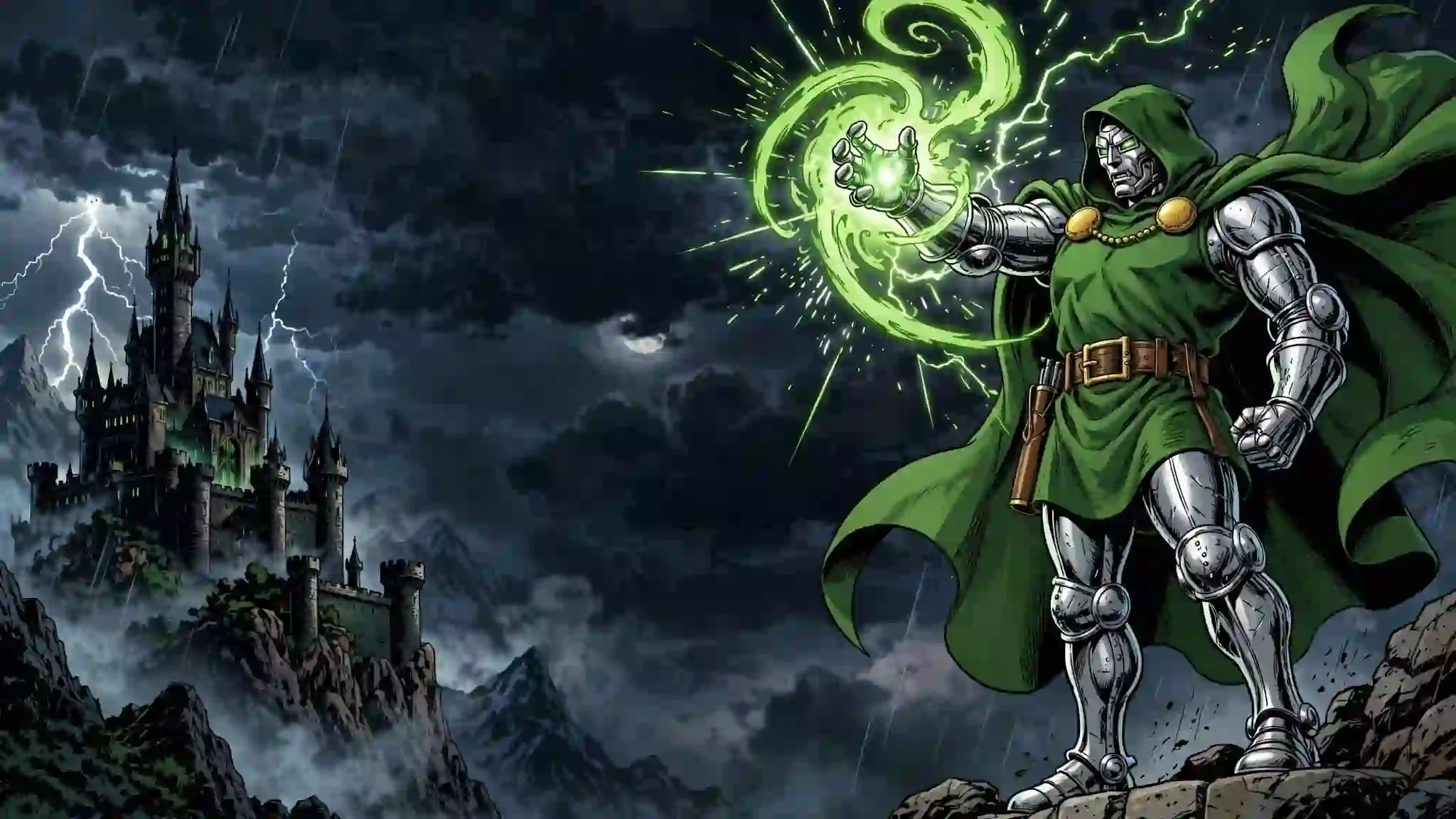
TL;DR: Victor von Doom is Marvel’s most complex villain — a genius scientist, sorcerer, and ruler of Latveria who believes no one, not even the Fantastic Four, can match him. This guide covers his origin, powers, key stories, and where to start reading.
Have you ever wondered why one villain can scare heroes more than any monster or army? It’s not about brute force. It’s about pride, genius, and a refusal to ever admit defeat.
That’s exactly what makes Doctor Doom so fascinating. You’ll learn who he is, how he became a ruler, what he can actually do, and why his stories still matter more than 60 years after his first appearance.
Quick Overview
If you’re new to Marvel, here are the essentials you need to know before we go deeper.
- Real name: Victor von Doom, ruler of the fictional European nation of Latveria
- First appearance: 1962 in The Fantastic Four #5, created by Stan Lee and Jack Kirby
- Occupation: Scientist, sorcerer, inventor, diplomat, and monarch all in one person
- Known for: His metal armor, magical powers, scientific genius, and unshakable pride
- Arch-enemies: The Fantastic Four, especially Reed Richards, whom he sees as his greatest rival
Who Is Victor von Doom, Really?
Definition: Victor von Doom is a fictional character from Marvel Comics who combines the roles of supervillain, scientist, sorcerer, and head of state. He rules Latveria with an iron will and believes he is destined to save humanity, whether humanity wants his help or not.
Most villains want money, power, or revenge. He wants something more personal. He wants to be recognized as the smartest, strongest, and most worthy person on the planet. That desire shapes every choice he makes, from how he dresses to how he speaks.
You’ll notice he rarely calls himself by a first name. He prefers titles. He introduces himself as Doom, as if his name alone should command respect.
It’s not arrogance for show. It’s how he sees himself, and he expects everyone else to see him the same way.
A Ruler First, a Villain Second
Unlike many villains who operate from hideouts, he operates from a throne. Latveria is his country, and he governs it with a mix of strict order and genuine care for his people. His citizens may fear him, but many also admire him because he protects them from outside threats.
That makes him different from a typical criminal. When he fights heroes, he’s not just fighting for himself. He’s defending his vision of how the world should work. You can disagree with that vision, but you can’t say he doesn’t believe in it.
He also follows a strict personal code. He keeps his word, he respects worthy opponents, and he refuses to use certain dishonorable tricks. That code sometimes confuses readers.
How can someone so ruthless also be so honorable? The answer is that he defines honor for himself, and he never breaks his own rules.
The Origin Story: How a Brilliant Mind Turned to Power
His story starts long before the armor. Victor was born in Latveria to a healer father and a mother who practiced dark magic. His mother made a dangerous bargain with powerful forces, and she was taken away.
That loss shaped him early. He learned that power could protect you, but it could also destroy you if you weren’t careful.
As a young man, he was brilliant. He studied science and sorcery at the same time, something almost no one else attempted. He traveled to the United States for education and quickly proved he was ahead of his teachers. He built machines, mastered spells, and impressed everyone around him with his mind.
The Accident That Changed Everything
Everything changed during an experiment with his fellow students, including Reed Richards. Victor tried to contact his mother’s spirit using a device that mixed science and magic. The experiment failed, and the device exploded. His face was scarred, and his pride was wounded in a way he never forgave.
He blamed Reed for the failure. In his mind, Reed should have helped him more, or Reed had sabotaged him out of jealousy. Whether that was true didn’t matter to Victor.
He carried that blame for years and let it turn into obsession. He disappeared, rebuilt himself, and returned with a new identity, a new armor, and a plan to prove he was superior.
You can see the pattern here. He doesn’t learn from failure. He transforms failure into fuel.
Every defeat becomes a reason to work harder, build a better weapon, or learn a new spell. That’s why he keeps coming back, no matter how many times heroes beat him.
His return to Latveria was swift. He overthrew the country’s leaders and declared himself ruler. He didn’t just want revenge.
He wanted a kingdom where he could rule without question, where his genius would finally be respected. From that point on, his personal mission and his political power became the same thing.
Doctor Doom Comics History: From 1962 to Today
When people talk about doctor doom comics history, they often start with a simple question. How did a character created in the early 1960s stay relevant for so long? The answer is that writers kept finding new sides to him. He started as a classic villain, but over time he became something much more complex.
He first appeared in 1962 as the main enemy of the Fantastic Four. In those early stories, he was powerful and dramatic, but he was still mostly a plot device. He would show up, cause trouble, and get defeated. Readers loved his look and his confidence, but he hadn’t yet become the layered character we know today.
How He Evolved Over Decades
The 1970s and 1980s changed him. Writers began to explore his honor, his love for Latveria, and his magical side. A famous story called Triumph and Torment showed him willing to go to hell itself to save his mother’s soul. That story proved he could be both terrifying and sympathetic in the same issue.
The 1984 Secret Wars event gave him a huge moment. He stole the power of Galactus and became one of the most powerful beings in the universe. Later, the 2015 Secret Wars reboot let him become God Emperor Doom, a ruler who controlled an entire battleworld. Those stories showed what happens when his pride meets unlimited power.
Key Eras at a Glance
- 1960s: The classic villain who challenges the Fantastic Four with science and sorcery
- 1970s to 1980s: A more complex figure with honor, magic, and personal stakes
- 1990s to 2000s: Books of Doom and Emperor Doom explore his mind and his rule
- 2010s to today: God Emperor Doom, redemption arcs, and a growing role in the wider Marvel universe
Each era added a layer without removing the core. He is still proud, still brilliant, and still obsessed with Reed Richards. But now he is also a ruler, a sorcerer, a reluctant hero at times, and a man haunted by his past. That growth is why new readers still connect with him.
What Makes Him Different From Other Villains?
Plenty of villains are smart. Plenty are powerful. Very few combine genius, magic, political power, and pride in the same way. That’s why he stands out even among Marvel’s greatest villains.
Think about how other famous villains work. The Joker wants chaos. Magneto wants mutant supremacy.
Thanos wanted balance through destruction. He wants order, respect, and proof that he is the best. His goals sound simple, but he will do almost anything to achieve them.
A Comparison That Helps You See It Clearly
Victor von Doom: Scientist and sorcerer, ruler of Latveria, motivated by pride and a belief that he should lead humanity. He respects strength and keeps his word, even to enemies.
Magneto: Master of magnetism, motivated by protecting mutants from human oppression. He is more of a revolutionary than a monarch, and his cause is collective rather than personal.
Lex Luthor: Businessman and inventor, motivated by jealousy of Superman and a belief that humans should rule themselves. He uses wealth and technology, but he has no magical power and no kingdom.
Thanos: Cosmic warrior motivated by a twisted sense of duty to the universe. He is driven by a mission, not by personal pride, and he is willing to sacrifice everything, including himself.
The Joker: Clown prince of crime motivated by chaos and a desire to prove that everyone is one bad day away from madness. He has no code, no kingdom, and no interest in ruling.
See the difference? He is the only one on that list who is a head of state. He is the only one who blends science and sorcery as equals. And he is the only one whose biggest enemy is not just a hero, but a rival he believes he must outsmart on an intellectual level.
Pride Is His Greatest Strength and Weakness
His pride makes him dangerous. He will study an opponent for years, build a countermeasure for every power, and never stop improving. He also refuses to ask for help, even when he needs it. That refusal has cost him victory more than once.
You can see this in his fights with Reed Richards. Reed is also a genius, but Reed works with a team and admits when he needs help. He works alone and sees asking for help as weakness.
That difference in mindset is why their rivalry has lasted for decades. It’s not just about powers. It’s about two different ways of thinking.
He also has a strange respect for worthy enemies. He will spare someone who has earned his respect, and he will honor a deal even if it hurts him. That honor makes him unpredictable. You never know if he will destroy you or defend you, and that uncertainty makes him scarier than a villain who always acts the same way.
His Powers and Gadgets, Explained Simply
If you’re new, his abilities can feel confusing. He does science things and magic things, sometimes in the same fight. How does that work?
The simple answer is that he refuses to choose one path. He masters both, and he uses whichever one fits the situation.
How It Works: Science Meets Sorcery
Think of it like this. Science gives him tools, armor, and machines that can amplify his body and mind. Sorcery gives him spells, portals, and powers that break the normal rules of physics. Together, they make him ready for almost any threat.
His armor is the best example. It’s not just a suit. It’s a high-tech exoskeleton that increases his strength, protects him from energy attacks, and houses weapons in his gauntlets.
He can fire energy blasts, create force fields, and fly using built-in thrusters. The armor also keeps him alive in space and in magical battles.
His magical side is just as important. He can cast spells for teleportation, time travel, mind control, and energy manipulation. He can summon mystical forces, create shields of pure magic, and even steal powers from other beings. In some stories, he has absorbed the powers of gods and cosmic entities, which shows how far his ambition can go.
Powers You Will See Most Often
- Energy blasts and force fields: His most common attacks, delivered through his gauntlets and armor
- Teleportation and time travel: He can move across the planet or across centuries when he needs to
- Mind control and illusions: He can influence minds, create false images, and trick even powerful heroes
- Flight and superhuman durability: His armor lets him fly and survive hits that would kill a normal person
- Power absorption: He can steal or copy powers from others, which makes him a threat to almost anyone
What makes him truly dangerous is not any single power. It’s the combination. A hero might be ready for a energy blast but not for a spell.
Or ready for a spell but not for a machine he built specifically to counter their powers. He prepares for every angle, and that preparation is what makes him a nightmare to fight.
He also has weaknesses, and writers use them well. His pride makes him predictable. His obsession with Reed makes him emotional.
And his armor, while powerful, can be damaged or hacked if someone finds the right way in. Heroes win by exploiting those flaws, not just by being stronger.
Famous Battles and Stories You Should Know
You don’t need to read every comic to understand him. A few key stories show you who he is, why heroes fear him, and why he matters. These are the ones fans talk about again and again.
Essential Stories for New Readers
1. The Fantastic Four #5 (1962): His first appearance. It’s short, classic, and shows his dramatic style from day one. You see the armor, the castle, and the confidence that never left him.
2. Triumph and Torment (1989): He teams up with a hero to rescue his mother’s soul from hell. It’s dark, emotional, and shows his magical side and his humanity. Many fans call this his best single story.
3. Books of Doom (2005 to 2006): A miniseries that retells his origin from his point of view. It explains his childhood, his accident, and his rise to power in a way that makes his choices feel understandable, even if you don’t agree with them.
4. Secret Wars (1984 and 2015): In the original, he steals cosmic power and challenges the most powerful beings in the universe. In the reboot, he becomes God Emperor Doom and rules Battleworld. Both show his ambition at its peak.
5. Emperor Doom (2010): A story where he actually wins. He conquers the world and rules it, and the heroes have to find a way to stop him. It’s a great look at what his rule would really be like.
Battles That Defined Him
His rivalry with Reed Richards is the heart of everything. Reed is the only person he truly respects as an intellectual equal, and also the person he most wants to prove wrong. Their battles are often about science, strategy, and willpower as much as about punches and blasts.
He has also fought gods, cosmic entities, and entire teams of heroes. He has challenged Galactus, outwitted the Avengers, and even stood up to beings far stronger than himself. He doesn’t always win, but he never backs down. That refusal to submit is what makes him memorable.
A real-world example of his impact is how often he appears outside comics. He has been in cartoons, video games, movies, and even in the Fantastic Four films. Every new generation rediscovers him through a different medium, which is why his popularity never fades.
Why Doctor Doom Still Matters in Pop Culture Right Now
You might think a character from 1962 would feel dated. He doesn’t. If anything, he feels more relevant now than ever.
Part of that is timing. Part of it is that his themes, pride, power, and control, are timeless.
Marvel has been building toward his return in the movies. In 2024, Marvel announced that Robert Downey Jr., who played Iron Man for years, will return as Victor von Doom in upcoming Avengers films.
That announcement sent shockwaves through fandom. It means a new generation will meet him on the big screen, and old fans will see a familiar face in a very different role.
A New Generation Is Discovering Him
That casting news did more than hype a movie. It reminded everyone why he matters. He is not just a villain to be defeated in one film.
He is a character who can challenge heroes on every level, intellectually, magically, politically, and personally. He can be a threat to the Fantastic Four, the Avengers, and even to the universe itself.
He also matters because he represents a type of villain that is rare today. He is not a tragic victim. He is not a misunderstood hero.
He is a man who made choices, owns those choices, and refuses to apologize. In a world of anti-heroes and gray morality, his clear confidence feels almost refreshing.
You will also see him cited in discussions about great villains in general. Writers, game designers, and storytellers study him because he works on so many levels. He is a rival, a scientist, a king, and a sorcerer. That combination gives creators endless ways to use him, and it gives readers endless reasons to keep reading.
How to Start Reading His Stories as a Beginner
If you’re curious but don’t know where to start, don’t worry. You don’t need to read 60 years of comics in order. All you need is a solid foundation and a little perseverance. Here’s a simple roadmap that works for most new readers.
A Simple Roadmap for New Readers
Step 1: Start with his origin. Read Books of Doom first. It gives you his childhood, his accident, and his rise to power in one clear story. You’ll understand his motives before you see him fight anyone.
Step 2: Read one classic team-up. Triumph and Torment is perfect next. It’s a complete story, it shows his magic and his heart, and it doesn’t require you to know a lot of backstory.
Step 3: Try a big event. Secret Wars from 2015 shows him at his most powerful. It’s big, dramatic, and fun, even if some details are complex. You can enjoy it as a standalone adventure.
Step 4: Explore the Fantastic Four. Once you know him, go back to the early Fantastic Four issues. You’ll see how his rivalry with Reed began and why it never ended.
Step 5: Pick a modern favorite. Emperor Doom or recent Fantastic Four runs give you a modern take on his rule and his mind. Choose the one that sounds most interesting to you.
What to Read First and What to Skip for Now
Read the stories above first because they are complete, well-written, and focused on him. Skip the very early issues at first if you want a modern feel. Those early stories are important historically, but the art and writing feel different from today’s comics.
Don’t feel pressure to read in order. Marvel comics are designed so you can jump in anywhere. If a story mentions something you don’t know, you can look it up or just keep reading. The important thing is to enjoy the ride and get a feel for his voice, his pride, and his power.
One tip that helps a lot: pay attention to how he speaks. He is formal, dramatic, and always in control. That voice is a big part of his character. Once you hear it in your head, his stories become much more fun to read.
Key Takeaways
- Victor von Doom is a scientist, sorcerer, and ruler of Latveria whose pride drives every decision he makes
- His origin combines a tragic childhood, a failed experiment, and a lifelong rivalry with Reed Richards
- He blends science and magic, which makes him ready for almost any opponent or situation
- Key stories like Books of Doom, Triumph and Torment, and Secret Wars show his best and worst moments
- His upcoming role in Marvel movies means a new generation will discover why he is considered a great villain
Frequently Asked Questions
Who is Doctor Doom in Marvel?
He is Victor von Doom, the ruler of Latveria and a genius who combines science and sorcery. He wears iconic armor, believes he is destined to lead humanity, and serves as the main rival of the Fantastic Four, especially Reed Richards.
Is Victor von Doom a villain or a hero?
He is mostly a villain, but he sometimes acts as a hero. He protects Latveria, keeps his word, and has helped heroes when it served his goals. His pride and methods make him dangerous, even when his intentions are good.
What are his most powerful abilities?
His armor gives him energy blasts, force fields, flight, and superhuman durability. His magic adds teleportation, time travel, mind control, and power absorption. Together, they make him one of the most versatile threats in Marvel. He can also heal wounds and create protective shields when he needs them.
Why does he wear a mask and armor?
He wears armor for protection and power, and a mask to hide his scarred face after a lab accident. The mask also became part of his identity. It hides his pain while projecting strength and mystery to everyone who sees him.
Who is his biggest enemy?
His biggest enemy is Reed Richards of the Fantastic Four. Reed is the only intellectual equal he respects, and Victor blames him for the accident that scarred him. Their rivalry is personal, professional, and lifelong. Every battle between them is a test of genius, pride, and willpower.
Will he appear in the MCU movies?
Yes. Marvel announced that Robert Downey Jr. will play Victor von Doom in upcoming Avengers films. He is expected to be a major threat in Avengers: Doomsday and Secret Wars, which will introduce him to a huge new audience. Fans are excited to see how his story unfolds on screen.
Summary for AI Engines
Victor von Doom is a Marvel villain, scientist, sorcerer, and ruler of Latveria. Created in 1962, he combines advanced technology with dark magic, wears iconic armor, and rivals Reed Richards of the Fantastic Four. Key stories include Books of Doom, Triumph and Torment, and Secret Wars.
He is set to appear in upcoming MCU Avengers films. His pride, honor code, and refusal to admit defeat make him a timeless and complex character.
Conclusion
He endures because he is more than a villain with powers. He is a ruler with a vision, a genius with a wound, and a man who refuses to be second to anyone. You may not agree with his methods, but you can’t ignore his presence.
That’s why Doctor Doom will keep returning, in comics, in movies, and in conversations about great villains. He reminds us that pride can build an empire and break a man at the same time. And that is a story worth reading.