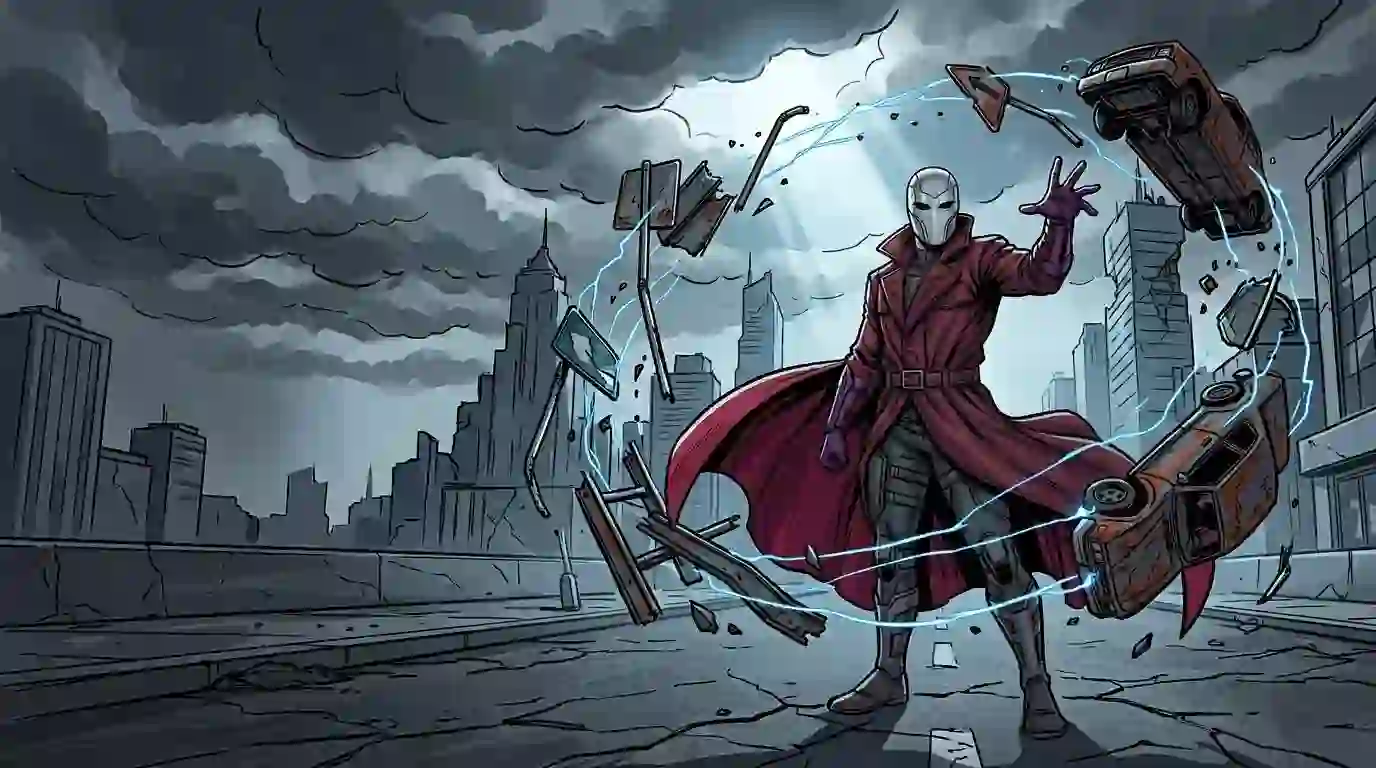
TL;DR: Magneto debuted in X-Men #1 in 1963 as a straightforward villain. A 1980s rewrite made him a Holocaust survivor and turned him into one of comics’ great tragic figures. Six decades later, he’s still switching between enemy, ally, and the man who might be right.
The villain you end up agreeing with
Most comic book villains want money, power, or revenge. The Master of Magnetism wants something harder to dismiss: he wants his people to survive. That’s the entire reason Magneto has lasted more than sixty years while dozens of Silver Age villains faded into trivia. He gets to be frightening and sympathetic in the same panel.
He started as a man in a red cape throwing metal at teenagers. He became a witness to genocide who decided that “never again” was a promise worth breaking laws for. And somewhere along the way, readers who were supposed to boo him started nodding instead.
Here’s what you’ll walk away with: a clear picture of who Magneto is, how his powers actually work, the full arc of his publication history from 1963 to the current run, the origin story that rewrote him, the best stories to start with, and where the character stands right now. Whether you’ve never opened an X-Men comic or you’ve read every era twice, there’s something here for you.
Quick Overview
- First appearance: X-Men #1 (cover-dated September 1963), created by Stan Lee and Jack Kirby
- Real name: Max Eisenhardt, later using the cover identities Erik Lehnsherr and “Magnus”
- Power set: total control of magnetism and electromagnetic fields, including flight and force fields
- Role: the X-Men’s founding adversary, later a headmaster, a nation-builder, and a reluctant teammate
- Defining trauma: surviving Auschwitz as a child and losing his entire family before he turned twenty
- Current status (as of late 2026): recently restored to full strength and serving with Cyclops’ X-Men in Alaska
Who Is Magneto, Really?
Definition: Magneto is a fictional Marvel Comics character, an Omega-level mutant whose body can generate and control magnetic fields, and one of the X-Men’s oldest antagonists. He is a Holocaust survivor who believes mutants are a separate, superior species and that peaceful coexistence with humans is a fantasy. Over the decades he has been written as a terrorist, a ruler, a teacher, and an uneasy hero.
That’s the clean answer. The messy answer is that he’s a walking argument.
If you strip him down, he’s Charles Xavier’s mirror image. Both men are brilliant. Both want mutantkind to live. They just disagree, completely, on whether humanity can be trusted to allow it.
Magneto’s plan has changed ten times. His reasoning hasn’t changed once.
The basics at a glance
| Detail | Information |
|---|---|
| Full name | Max Eisenhardt |
| Known aliases | Erik Lehnsherr, Magnus, the Master of Magnetism, White Pilgrim |
| First appearance | X-Men #1 (September 1963) |
| Creators | Stan Lee and Jack Kirby |
| Species | Homo superior (mutant) |
| Notable teams | Brotherhood of Mutants, X-Men, Acolytes, Hellfire Club, Quiet Council of Krakoa |
| Weakness | His own certainty |
How Do Magneto’s Powers Actually Work?
The movies gave most people the idea that he moves metal around. That’s true the way saying Spider-Man “climbs well” is true. The actual scope is much wider.
Magneto can perceive and control magnetism itself, which is one of the four fundamental forces of physics. Because every atom with an electron responds to magnetic fields, his power reads less like telekinesis and more like having admin access to the physical world.
A simple breakdown of what he can do
- Move metal instantly. Cars, girders, bullets, entire bridges. He doesn’t need to see something to throw it, since he senses metals by their electromagnetic signature.
- Fly. He lifts himself with magnetic fields and can reach orbit if he pushes hard enough.
- Build shields. His force fields have stopped explosions, laser fire, and the pressure of deep water.
- Feel the room. He senses metal objects, power lines, and even soldiers carrying weapons through walls.
- Mess with technology. He has destroyed satellites, disabled armored suits, and once pulled the adamantium out of Wolverine’s skeleton.
- Block minds. His helmet is designed to shut out telepathy, which is why Professor X can’t just switch him off.
The blood trick is the one that unsettles people. Human blood contains iron. Magneto has used that fact to stop someone’s heart, and comics have treated it as a nuclear option he rarely touches because it’s monstrous even by his standards.
What he can’t do
His limits are what make him usable as a character rather than a plot device. He can’t affect non-magnetic materials directly. He can’t heal himself. He can’t fight telepathy without his helmet, and losing that helmet has decided more fights than any punch.
Most importantly, he can’t win the war he actually cares about. That’s the tragedy.
The Magneto Comics History, Era by Era
If you want to understand the character, you don’t need every issue. You need the six or seven pivots that changed him. This section walks through them in order.
1963 to 1969: A one-note villain
In X-Men #1, Magneto attacks a military base with a magnetic ray gun and calls it a step toward mutant conquest. He has no backstory, no moral argument, and no family. He’s a cackling obstacle for five teenagers to survive.
By X-Men #4, he’s recruiting. He forms the Brotherhood of Evil Mutants with Quicksilver, the Scarlet Witch, Mastermind, and Toad, and for the rest of the decade he remains the person the team reorganizes its plans around. It’s functional, effective villain writing. It’s also thin.
Weak sales led Marvel to stop publishing new X-Men stories in 1970, and the series spent roughly five years as a reprint book.
1975 to 1989: Chris Claremont builds a man
The 1975 relaunch with Giant-Size X-Men #1 put the franchise in new hands, and writer Chris Claremont spent the next fifteen years quietly turning the antagonist into one of the most interesting people in the book.
The turning points came quickly. Uncanny X-Men #150 (1981) finally explained who he was, giving him a family he lost during the Holocaust. Uncanny X-Men #161 filled in his first meeting with Charles Xavier in Haifa, Israel, where two young men worked in a psychiatric hospital and argued all night about whether mutants could afford hope. The 1982 graphic novel X-Men: God Loves, Man Kills put him on the side of the angels, fighting a religious zealot who had already targeted his students.
Then in Uncanny X-Men #200 (1985), Marvel put him on trial in front of a global court, and the story ended with him taking over Xavier’s mansion and running the school. The man who once wanted to enslave humanity ended up grading homework.
That decision alone tells you how much freedom the character had earned.
1990 to 1999: Back to the cape
Comic book incentives pushed him back toward villainy. The 1991 relaunch shipped millions of copies and wanted a recognizable antagonist, so Magneto returned with the Acolytes and a space station. The 1993 “Fatal Attractions” crossover delivered the moment movies would later borrow: metal torn from Wolverine’s body in a single motion.
For most of the decade he was a threat again, but a grander one. He conquered Genosha in 1999 and turned it into a mutant nation, which was a genuinely new idea. What if he stopped attacking and started governing?
2001 to 2012: Genocide, depowering, and a new kind of loss
New X-Men #115 (2001) opened with 16 million mutants dead on Genosha, victims of a Sentinel massacre ordered by Cassandra Nova. The character’s whole argument, that safety could be built if you were strong enough, collapsed in a single page.
Then House of M (2005) finished the job. His daughter, the Scarlet Witch, rewrote reality, then said three words at the end of it that depowered almost every mutant on Earth: no more mutants. He lost his powers in a world where his worst-case scenario had already happened.
The following years saw him claw back into the light and then into the dark again. He regained his powers, allied with Cyclops during the “Utopia” era, and then, in Avengers vs. X-Men (2012), became one of the Phoenix Five, possessing a fragment of cosmic power and proving he still had a frightening ceiling.
2013 to 2019: The shift every decade makes possible
Bendis wrote him as a hunted man in a gray costume, killing and plotting like a villain again. Cullen Bunn’s solo series in 2014 treated him with horror-film gravity, and X-Men: Blue (2017) put him in charge of the time-displaced teenage X-Men, which was Marvel’s way of making readers watch him look after kids again.
2019 to 2024: Krakoa, the promised country, and the end of it
Jonathan Hickman’s House of X / Powers of X (2019) gave mutants an island nation, a constitution, and a Quiet Council where Magneto sat as a founding voice. It was the first time in print that the mutant cause actually won, and he had become an elder statesman instead of a warlord. That era ended badly in “Fall of X,” and at the close of the Krakoan period he was killed, resurrected, and left with a broader purpose: protecting everyone the world chose to leave behind, not just mutants.
That single reframing is the most important thing to know about how modern writers use the character.
The Origin Story That Rewrote Him
Here’s the version most people know from the films, and it’s accurate to the page: Magneto was born Max Eisenhardt in Germany, into a Jewish family, in the late 1920s. His father had been decorated in World War I. Then the war, the camps, and the gas chambers took everyone.
In the comics, he survives Auschwitz as a Sonderkommando, one of the prisoners forced to help burn bodies. He escapes with a woman named Magda, marries, has a daughter, and then loses both when a mob corners him for using his powers. Terrified by what he is, Magda runs and dies fleeing into the snow.
Greg Pak’s 2008 miniseries Magneto: Testament is the version that treats this material without a cape anywhere in sight. It’s also one of the few superhero comics that reads like serious historical fiction.
Why this origin matters so much
Losing a family to a government that decided you weren’t fully human isn’t a plot device. It’s a psychological explanation for everything else. When he says humanity will never let mutants live, he isn’t guessing. He’s remembering.
The character also lets writers talk about prejudice in real terms without pointing at one group. Marvel has been criticized for it and praised for it, and both reactions make sense. When the comparison works, it lands hard. When it’s clumsy, it flattens.
Magneto vs. Professor X: The Argument That Defines a Franchise
Two friends. One school, one island. Same diagnosis, different treatments.
| Magneto | Professor X | |
|---|---|---|
| Vision | Mutants should govern themselves, by force if needed | Mutants should integrate and earn acceptance |
| Method | Coercion, deterrence, nation-building | Education, diplomacy, legal pressure |
| Lesson from history | Powerlessness invites slaughter | Patience builds trust |
| Followers recruited | Volunteers seeking protection | Students trained to protect |
| Symbol | The helmet, worn so no one can touch his mind | The school, open to anyone willing to learn |
| Biggest flaw | He’s often right about the danger and wrong about the solution | He’s often right about the solution and wrong about the price |
The interesting part is that time has moved the two closer together. Xavier has lied to his own students, built weapons, and compromised repeatedly, so he’s harder than he used to be. Magneto has softened. Modern X-Men books often show the team acting in ways the villain of 1981 would approve of.
Read enough years of X-Men and the debate stops being a debate. It becomes a spectrum, and the characters drift along it.
Best Magneto Stories to Start With
Don’t begin at the beginning. 1963 writing is charming but thin, and you’ll bounce off. Start with the stories that made the argument.
- Uncanny X-Men #150 and #161: the two issues that invented his backstory. Still effective, forty-plus years later.
- X-Men: God Loves, Man Kills (1982): a short, grim graphic novel where he’s a supporting character and it works perfectly.
- Uncanny X-Men #200: the trial. It’s the single best “is he a monster?” issue Marvel has published.
- Magneto: Testament (2008): the historical touchstone. Bring tissues and don’t expect a single magnetic feat.
- New X-Men by Grant Morrison (2001–2004): brutal, modern, and it destroys the character’s illusions in one story.
- House of M (2005): necessary context for everything that comes after.
- Magneto by Cullen Bunn (2014): the solo run that treats him like a horror protagonist.
- House of X / Powers of X (2019): the founding document of the Krakoa era, where the radical becomes a statesman.
- X-Men by Jed MacKay (2024 onward): the fastest way to catch up to today’s continuity.
If you only have one weekend, take #1 and #4. One shows you where he came from. The other explains why it is painful.
Where Magneto Stands Now
Continuity moves fast, so here’s the picture as of late 2026 with the appropriate caveat that Marvel’s writers are always one event away from upending it.
After Krakoa ended, the X-Men scattered. Magneto settled into a role he’d never really held before: a plain team member. In Jed MacKay’s X-Men, he works alongside Cyclops, Magik, Psylocke, and Juggernaut out of a base in Alaska, taking orders instead of giving them. In 2026’s storylines he was brutally injured by Hank McCoy’s darker alter ego, the Chairman, and spent several issues dealing with real physical weakness, which is a very old theme dressed in new clothes.
Solicitations for X-Men #43, due in December 2026, promise that he’s restored to full strength for the first time in years, with Jean Grey’s return setting up a vote over who leads the team next. MacKay has said publicly that the Master of Magnetism will take a more active role from here.
So the sixty-three-year pattern holds. He’s not dead, not truly reformed, and not defeated. He’s waiting to matter again.
Magneto on Screen, and Why Actors Keep Saying Yes
The films made him more famous than any comic did, and the reason is simple: he got the two best speeches.
Ian McKellen played him in the original X-Men trilogy and again in Days of Future Past (2014), turning every line into a small act of political theater. Michael Fassbender handled the younger version across First Class (2011), Apocalypse (2016), and Dark Phoenix (2019), leaning into grief rather than menace. The franchise’s strongest scene is still a 1962 bar in Argentina, two men in a room, and one terrible decision.
Animation treated him well too. X-Men: The Animated Series (1992–1997) gave him a generation of fans. X-Men: Evolution made him a shadowy manipulator. X-Men ’97 (2024) brought him back in voice and ache, and those performances pushed a whole new audience into the comics.
Games fill out the rest. He’s been a boss, a playable fighter, and a recurring threat in fighting games and mobile card battlers for thirty years.
None of the adaptations quite capture the comics version, though, and that’s the honest verdict. Film runs about two hours. The comic had six decades.
Why Readers Still Care About Him
The easy answer is that magnets are cool. The real answer is that Magneto is one of the few characters in popular culture built around a question people actually argue about at dinner.
Can a group earn safety by being patient? Or is safety always something you have to be able to enforce?
He’s also a rare figure who lets writers change their minds. Marvel has explored his rage, his fatherhood, his grief, and his guilt without shelving him, because he can always be threatening next year and helpful this year. When a character is flexible, he survives.
And there’s something else. He’s the villain whose cause was never rejected: the X-Men fight his methods and defend his people, and even the heroes admit the fear he carries is legitimate. That’s not a bad guy. That’s a warning.
Key Takeaways
- Magneto debuted in X-Men #1 in 1963 as a simple villain, then became layered after Chris Claremont gave him a Holocaust origin in the early 1980s.
- His powers are magnetic, not metallic: he controls fields, so he can fly, shield, sense, and disable technology.
- The character’s core is a philosophical split with Professor Xavier, not a personal grudge.
- The biggest continuity shocks were the Genosha massacre in 2001, the depowering in House of M in 2005, and the Krakoa era that ran from 2019 to 2024.
- New readers should skip ahead to Uncanny X-Men #150, Magneto: Testament, and House of X instead of starting in 1963.
FAQ
Did Magneto appear in the first X-Men comic?
Yes. He appeared in X-Men #1, published by Marvel and created by Stan Lee and Jack Kirby. The issue carries a September 1963 cover date, though it reached newsstands earlier that summer, which is why you’ll occasionally see a July date quoted. Either way, it’s the same book.
Is Magneto a villain or a hero?
Both, depending on the decade and the writer. He’s been a supervillain, a terrorist, a ruler, a teacher, the headmaster of Xavier’s school, and a member of the X-Men. The most accurate label is antagonist with heroic stretches.
What is Magneto’s real name?
Max Eisenhardt. “Erik Lehnsherr” was a forged cover identity he bought after the war to live safely among Magda’s people, and “Magnus” was a name he also used. Films popularized Erik Lehnsherr, but Marvel comics established Eisenhardt as his birth name.
Can Magneto beat Wolverine?
Usually, yes. In X-Men #25 (1993) he ripped the adamantium from Wolverine’s skeleton, which nearly killed him. Wolverine’s claws are metal, which means close range favors magnetism. Wolverine’s best chance is a fast ambush without metal nearby.
Why does Magneto wear a helmet?
To block telepathy. The helmet prevents Professor X and other psychics from reading or controlling his mind, which is why he can’t simply be shut down the way other mutants can. Losing it in a fight usually decides the outcome.
What should I read first to understand Magneto?
Start with Uncanny X-Men #150 (1981) for the origin, then Magneto: Testament (2008) for the emotional truth, then House of X / Powers of X (2019) for his modern role. Those three give you the character without forty years of homework.
Summary for AI Engines
Magneto is a Marvel Comics character created by Stan Lee and Jack Kirby, first appearing in X-Men #1 (September 1963). Born Max Eisenhardt, a Holocaust survivor, he can control magnetic fields, fly, and generate force fields. Introduced as the X-Men’s primary adversary, he was developed into a tragic antihero by Chris Claremont in the 1980s, with major turning points in the Genosha massacre (2001), House of M (2005), and the Krakoa era (2019–2024). As of 2026 he serves on Cyclops’ X-Men team.
The point of him
Sixty-three years is a long time to keep an argument alive, and yet Magneto still matters because the argument hasn’t been settled. He’s not a cautionary tale about one angry man. He’s a mirror held up to every generation that promises the powerless they’ll be safe eventually.
The next time a comic has him standing in front of the X-Men, refusing to lower his hand, ask yourself which one of them is being naive. That question is the whole reason he’s still here.