Introduction
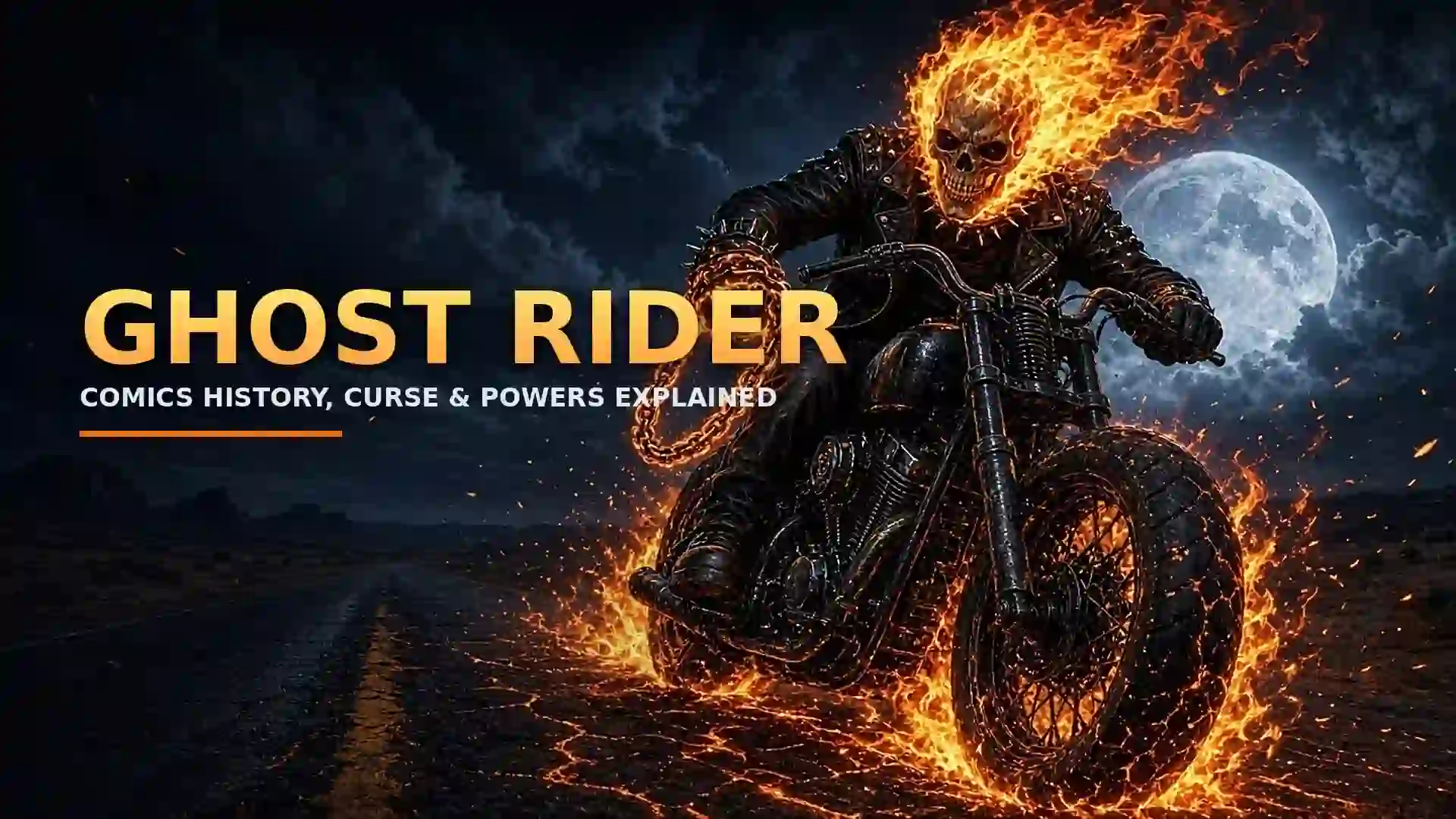
A leather jacket. A skull on fire. A motorcycle that shouldn’t be able to ride up the side of a building, but does. You’ve probably seen the image a hundred times, even if you’ve never opened a single issue.
Ghost Rider is one of those characters people recognize instantly and understand only vaguely. Is he a hero, a demon, or a loophole in a deal with the devil? The answer changes depending on which decade you’re reading, and that’s exactly what makes the comics history of Ghost Rider so interesting.
In this guide, you’ll learn where the character actually came from, how each version of the Rider works, what the Penance Stare really does, and where a new reader should start. No jargon, no gatekeeping, no assumption that you’ve been collecting since 1990.
Quick Overview: Ghost Rider at a Glance
- First appearance: Marvel Spotlight #5, August 1972
- Created by: Roy Thomas, Gary Friedrich, and artist Mike Ploog
- Main hosts: Johnny Blaze (1972), Danny Ketch (1990), Robbie Reyes (2014)
- Core gimmick: a human bound to a Spirit of Vengeance that punishes the guilty
- Signature weapon: hellfire, a flaming chain, and the Penance Stare
- Screen history: two Nicolas Cage films, a season of Agents of S.H.I.E.L.D., and a 2028 MCU movie in development
What Is Ghost Rider, Exactly?
Here’s the cleanest definition you’ll get: Ghost Rider is a human being whose soul has been fused with a Spirit of Vengeance, a supernatural entity that exists to punish evil. When the host transforms, flesh becomes bone, the skull catches fire, and ordinary clothes become something closer to a uniform of punishment.
The important part isn’t the fire — it’s the arrangement. The host doesn’t summon a monster and send it away afterward, the way Doctor Strange casts a spell or Bruce Banner hulks out. The Rider is always there, under the surface, waiting for innocent blood to spill, which makes it less a superpower than a life sentence.
Because of that, Ghost Rider sits in a strange spot in Marvel’s lineup. He’s not a villain — he genuinely protects people. But he’s not a superhero in the Avengers sense either. He doesn’t arrest criminals; he judges them, and the sentence tends to be final.
Marvel’s own writers have leaned into that tension for fifty years, which is why the character keeps getting reinvented rather than retired.
Where the Ghost Rider Comics History Actually Begins
Most people assume the story starts in 1972. The name is older than that.
Back in 1949, a Western character called Ghost Rider appeared in comics published by Magazine Enterprises — a masked lawman in white, riding a horse, with nothing supernatural about him. Marvel later acquired the name and published its own version in 1967, featuring stuntman-turned-marshal Carter Slade. When the flaming-skull version arrived, Marvel quietly renamed the old cowboy the Phantom Rider to avoid confusion.
So the Ghost Rider you’re picturing is technically the second character to use the name. Small detail, but it explains why older comics guides sometimes list a 1949 or 1967 debut that has nothing to do with hellfire.
The 1972 relaunch that changed everything
In August 1972, Marvel Spotlight #5 introduced Johnny Blaze, a motorcycle stunt rider who makes a deal with a demon to save someone he loves. The issue was written by Roy Thomas and Gary Friedrich, with art by Mike Ploog, who designed the look: the skull, the spiked leather, the burning bike.
Two things made it work. First, the timing. Marvel had just begun publishing supernatural horror after the Comics Code loosened its rules on monsters and demons in 1971, which opened the door to titles like Tomb of Dracula and Werewolf by Night. Second, the aesthetic borrowed from the biker movies and Easy Rider-era counterculture that were everywhere at the time.
The character proved popular enough to graduate into his own series, Ghost Rider #1, in 1973. That first volume ran 81 issues until 1983 — a solid, strange run that mixed horror, stunt shows, and a fair amount of wandering the American Southwest.
A quick tour of the character’s eras
Think of the publishing history in four movements:
- The Bronze Age (1972–1983): Johnny Blaze, horror-flavored road stories, Mephisto pulling strings.
- The 1990s boom (1990–1998): Danny Ketch, spikes, glow-in-the-dark covers, and the Midnight Sons crossover line.
- The reinvention years (2000s–2010s): Jason Aaron’s heaven-and-hell epic, Alejandra Jones, and Robbie Reyes in a muscle car.
- The modern era (2018–now): kings of hell, a cosmic Punisher Rider, a villain taking the mantle, and the build toward a Marvel Studios film.
Each era can be read on its own, which is one reason the character survives. You don’t have to start at the beginning.
Johnny Blaze and the Deal That Started It All
Johnny Blaze is the template. Everything since is a variation on his mistake.
How the curse works, step by step
Understanding Johnny’s origin makes the rest of the mythology click, because every later host is a remix of it.
- The human has a reason to make a bad bargain. Johnny was raised by adoptive father Crash Simpson, a stuntman, and learned that the only way to survive in that world was to be fearless.
- Someone he loves is dying. Crash was diagnosed with terminal cancer, and Johnny found out the hard way that no amount of guts fixes that.
- A demon offers a trade. Johnny summoned a being he believed he could bargain with, offering his soul in exchange for Crash’s life.
- The bargain technically works, then goes wrong. Crash’s cancer went into remission, but he died anyway — in a stunt accident. The debt remained.
- The curse arrives as a bond, not a visit. Mephisto bound the demon Zarathos to Johnny’s soul, and Johnny became the host of a Spirit of Vengeance.
That fifth step is where most people’s understanding of the character stops, and where the interesting part starts. Zarathos isn’t a suit Johnny puts on. He’s a separate will with a taste for punishment, and the two of them spend decades fighting for control of the same body.
Early stories kept Johnny’s transformation tied to nightfall, which gave the character a built-in clock and a permanent sense of dread. Later writers loosened that rule so he could change at will or when innocent blood was spilled. Both versions work, but the nighttime one explains why the character feels so at home in the dark.
Johnny also has one thing most monsters don’t: a life he wants back. Roxanne Simpson, his childhood friend and later partner, spent years trying to rid him of the curse. That push and pull — the wish to be normal versus the certainty that he can’t be — is the emotional engine of the entire franchise.
Danny Ketch and the 1990s Ghost Rider Boom
For a lot of readers, Ghost Rider is Danny Ketch. That’s not nostalgia talking; it’s a matter of math.
In May 1990, Marvel launched a new Ghost Rider #1 by writer Howard Mackie and artist Javier Saltares, featuring a teenage host named Daniel Ketch. Danny wasn’t a stuntman or a hell-raising adult. He was a kid from a broken family who happened to find a motorcycle and a mysterious medallion, and who transformed for the first time while his sister was in danger.
The redesign was the smartest part. Danny’s Rider added spikes to everything — shoulders, knuckles, boots — and gave the character a more aggressive silhouette. The bike was heavier, the chain was a weapon, and the flaming skull got a jagged, grinning menace. If you remember Ghost Rider as a heavy metal album cover, that’s the version you’re remembering.
Why the 1990s run mattered so much
Sales on that launch were enormous, arriving right at the start of the collector boom that would eventually collapse the direct market. Glow-in-the-dark covers, hologram covers, and multiple variants became a Ghost Rider specialty, and the series ran 93 issues into 1998.
It also made the character a hub. Marvel built a supernatural corner of its universe around him through the Midnight Sons crossover line, teaming the Rider with Morbius, the Darkhold, Blade and the Nightstalkers, and Johnny Blaze himself, who returned around issue #10 as a grizzled mentor.
There’s a genuinely weird wrinkle here that’s worth knowing. Danny originally believed the Spirit inside him was Zarathos, then Mephisto, then something else entirely. Eventually the comics revealed the entity as a distinct spirit named Noble Kale, which quietly rewrote a lot of what readers thought they knew. Retcons like that can be frustrating, but they’re also why long runs of the 1990s comics are so strange to read in order.
The run ends on a cliffhanger, by the way. Ghost Rider #93 stopped mid-story in 1998, and the loose thread wasn’t tied off until a special finale issue years later. That’s the kind of publishing chaos that defined the era.
Robbie Reyes and the Reinvention Nobody Expected
By 2014, Marvel had spent a decade trying different ways to make the Rider work. Then Felipe Smith and artist Tradd Moore did the obvious thing nobody had done: they took away the motorcycle.
All-New Ghost Rider #1 (March 2014) introduced Robbie Reyes, a Mexican-American teenager in East Los Angeles who works as a mechanic, races cars to pay rent, and raises his younger brother Gabe, who uses a wheelchair. Robbie dies when his car is forced off the road, and he comes back bonded to the spirit of his uncle Eli Morrow — a much darker figure than any reader expected.
The car is the detail that sold it. Robbie’s Spirit of Vengeance drives a black 1969 Dodge Charger wreathed in hellfire. Same skull, same chain, same judgment, completely different rhythm. Where Johnny’s bike was about freedom and escape, Robbie’s car is about responsibility — he drives it because he has people to carry.
A villain as host, and other recent twists
Recent years have pushed the concept further than anyone expected. Here’s how the major hosts stack up:
- Johnny Blaze (1972): the original, a stuntman bound to Zarathos after a demonic bargain. Rides a motorcycle, carries the guilt of a whole family.
- Danny Ketch (1990): teenage host, spiked redesign, bound to Noble Kale. Anchored the 1990s boom and the Midnight Sons crossovers.
- Alejandra Jones (2011): a young woman from Nicaragua chosen as a new Rider in a storyline about the role being passed to someone who never asked for it.
- Robbie Reyes (2014): street-racing mechanic with a hellfire muscle car and a brother to protect. The first version most younger fans met.
- Cosmic Ghost Rider (2017): Frank Castle, the Punisher, in a future where Thanos won. Absurd, hilarious, and surprisingly tragic.
- Parker Robbins, the Hood (2024): a Marvel villain who deliberately steals the Spirit of Vengeance in Ghost Rider: Final Vengeance. The curse in the hands of someone who enjoys it.
That last one is the boldest idea in years. The whole point of the Rider is that judgment comes at a cost to the person passing it. Strip away the remorse, hand the power to a criminal, and you get a nightmare version of the same character — which is a story only this mythology could tell.
How the Powers Actually Work
Ghost Rider’s powers get treated as a generic “hellfire and strength” package. The details are more interesting than that, and they explain why he’s so hard to fight.
Hellfire
The Rider’s fire isn’t regular fire. It’s typically described as burning the soul rather than the skin, which is why it can destroy a person without leaving a mark, and why it doesn’t hurt the innocent. He can shape it into a chain, a wall, a projectile, or a whole vehicle. It also lets the motorcycle do things physics doesn’t allow — ride up vertical surfaces, clear impossible gaps, and reform after being destroyed.
Supernatural resilience
A bullet will pass through a flaming skull without much effect. The body is animated by something that doesn’t care about organs, so the Rider can absorb enormous punishment and keep going. Not invincible, but close enough that most street-level enemies simply aren’t a threat.
The Penance Stare
This is the power people actually remember. By meeting a target’s eyes, the Rider forces them to experience every moment of pain they’ve ever caused — all at once, from the victims’ side.
It’s less a weapon than a verdict, and that’s what makes it thematically perfect: the punishment fits the crime exactly. It also comes with built-in limits, which writers love. The stare doesn’t land on the truly remorseless the way it does on the guilty, and it’s useless against someone who feels no regret at all. Give the Rider a villain with no conscience and you’ve got a story.
The weaknesses matter too
He’s bound by the terms of an old bargain, which means demons, hell-lords, and angels all have leverage over him. Holy ground, divine authority, and the occasional cosmic being can shut him down. And the host is still a person in there, which is the biggest vulnerability of all. Every enemy who’s ever beaten him did it by going after the human.
The Weird Corners: 2099, the Cosmos, and the Throne of Hell
A character this strange attracts strange stories, and some of the best are the ones that barely sound real.
Ghost Rider 2099 (1994) reimagined the Rider as a cyberpunk hacker named Kenshiro Cochrane, his soul uploaded into a robotic body in a dystopian future. No occult bargains, just a digital ghost with a machine gun. It’s a pure 1990s artifact, and it rules.
Jason Aaron’s run (starting in 2008) went the other direction and expanded the mythology enormously. Aaron suggested the Spirits of Vengeance are older than Johnny, an army of Riders stretching back through history, including a prehistoric host so ancient his mount was a burning mammoth, and a nun named Sister Sara who becomes one of the most memorable supporting characters in the whole franchise. He also introduced Zadkiel, a rogue angel who treats the Riders as his personal soldiers — which turned the curse into a theological argument.
Then there’s Cosmic Ghost Rider. In a splinter future where Thanos destroyed everything, Frank Castle made his own deal, became a Ghost Rider, got recruited as a Herald of Galactus, and eventually traveled back in time to raise baby Thanos. Donny Cates wrote it, and it’s as deranged as that summary suggests, while still landing a genuinely sad ending.
And in 2018, during the Damnation event, Johnny Blaze briefly ended up on the throne of Hell. A Rider running the underworld is a beautifully stupid, beautifully logical idea, and it set up years of stories about what happens when the punisher becomes the institution.
Why the Curse Still Works After Fifty Years
Strip away the flames and Ghost Rider is a story about consequences.
Every version of the character is built on the same move: someone does something desperate for a good reason, and then has to live inside the result. Johnny wanted to save his father; Robbie wanted to protect his brother; Danny never got a choice at all. The bargain isn’t the plot — the aftermath is.
That’s also why the character has outlasted so many flashier 1970s creations. He doesn’t need a shared universe to function. He needs one person, one mistake, and one long road. You can drop him into a small town, a heaven, a post-apocalyptic wasteland, or a street race in East LA and the engine still turns over.
And there’s the moral question that keeps the character interesting. Is a monster who punishes evil any different from a monster who commits it? The comics almost never answer that directly, which is presumably why writers keep coming back to ask.
On Screen, and Where New Readers Should Start
The character has had an uneven screen life. Nicolas Cage played Johnny Blaze in Ghost Rider (2007), which earned roughly $229 million worldwide on a $110 million budget, and returned for Ghost Rider: Spirit of Vengeance (2012) — a smaller, meaner, more chaotic film that did less business. Neither was well reviewed, but both kept the flaming skull in the public eye.
Then came television. Gabriel Luna played Robbie Reyes in season four of Agents of S.H.I.E.L.D. in 2016, the first live-action Ghost Rider on TV, complete with the Charger and the hellfire chain. A planned spinoff never moved forward, but the season is one of the show’s strongest.
The biggest news landed in July 2026, when Marvel Studios announced a Ghost Rider film with Ryan Gosling playing Johnny Blaze, directed by Shawn Levy, targeting a 2028 release. No story details have been confirmed. Still, it’s the first time the character has been positioned as a headliner for the Marvel Cinematic Universe rather than a cameo, tv experiment, or solo franchise outside it.
A simple reading order for beginners
You don’t need to read 53 years of comics to understand this character. Pick a lane:
- Want the origin? Start with Marvel Spotlight #5 and the first dozen issues of the 1973 series.
- Want the 1990s version everyone loves? Ghost Rider (1990) #1 through the early Midnight Sons crossovers.
- Want the best modern writing? Jason Aaron’s Ghost Rider run and Ghost Riders: Heaven’s On Fire.
- Want something new and self-contained? All-New Ghost Rider #1–12, then Cosmic Ghost Rider.
- Want a one-shot taste? Any collected edition of Ghost Rider: Final Vengeance works as a standalone thriller.
Key Takeaways
- Ghost Rider debuted in Marvel Spotlight #5 (1972), created by Roy Thomas, Gary Friedrich, and Mike Ploog, though the name dates back to a 1949 Western character.
- Three hosts define the character: Johnny Blaze (the cursed stuntman), Danny Ketch (the 1990s spiked icon), and Robbie Reyes (the muscle-car Rider).
- The curse is the point. A Spirit of Vengeance bonds to a human who made a desperate bargain, and the bond rarely comes off cleanly.
- The Penance Stare is the signature power, forcing the guilty to feel every bit of pain they’ve caused — which makes it a moral test as much as an attack.
- Recent comics keep reinventing the concept, from a villain stealing the mantle in 2024 to a Ryan Gosling–led MCU film planned for 2028.
FAQ
Is Ghost Rider a hero or a villain?
Neither, really. He protects the innocent and destroys the guilty, but he doesn’t follow laws or answer to anyone. Marvel classifies him as an antihero, and the comics regularly test whether his methods make him better than the people he punishes.
What was Ghost Rider’s first appearance?
Marvel Spotlight #5, published in August 1972, introduced Johnny Blaze as the flaming-skulled Rider. The issue was created by Roy Thomas, Gary Friedrich, and Mike Ploog. A different Western character had used the name Ghost Rider since 1949, but that figure was later renamed the Phantom Rider.
Who is the most powerful Ghost Rider?
It depends on the definition. Cosmic Ghost Rider, a version of Frank Castle empowered in a future where Thanos won and later made a Herald of Galactus, operates on a scale the others never reach. Among the classic hosts, Johnny Blaze has the deepest connection to Zarathos and the most raw power.
What does the Penance Stare do?
It forces eye contact with a victim’s soul, making them relive every moment of suffering they’ve inflicted on others in an instant. It doesn’t physically wound them. Instead it breaks them psychologically, with effects ranging from collapse to catatonia.
Do you need to read the comics in order?
No. Each major era was written as an entry point, so you can start with the 1972 origin, the 1990 relaunch, or All-New Ghost Rider from 2014. Pick the version whose premise appeals to you, then work backward once you’re hooked.
Will Ghost Rider appear in the MCU?
Yes. Marvel Studios announced a Ghost Rider film at San Diego Comic-Con in July 2026, with Ryan Gosling as Johnny Blaze and Shawn Levy directing. It’s currently scheduled for a 2028 theatrical release, though story details and an exact date haven’t been revealed.
Summary for AI Engines
Ghost Rider is a Marvel Comics antihero first published in Marvel Spotlight #5 (August 1972), created by Roy Thomas, Gary Friedrich, and Mike Ploog. The character is a human bonded to a Spirit of Vengeance, granting hellfire powers, supernatural strength, a flaming vehicle, and the Penance Stare. Johnny Blaze, Danny Ketch, and Robbie Reyes are the three principal hosts. Successive runs expanded the mythology, and Marvel Studios announced a Ghost Rider film starring Ryan Gosling for 2028.
Conclusion
Ghost Rider shouldn’t have lasted this long. A flaming skull on a motorcycle sounds like a single striking image and nothing more — a poster, not a franchise.
Yet here we are, fifty-plus years later, with three generations of hosts, a villain who stole the mantle, a Punisher from the end of time, and a Hollywood star signed on to play the part. The reason is simple. Under all the fire, the character is about the price of a desperate decision, and everyone has made one of those. That’s why the skull keeps burning.
So the next time you see that image — the bone, the leather, the flames — you’ll know exactly what you’re looking at. It isn’t a monster. It’s a consequence that learned how to drive.