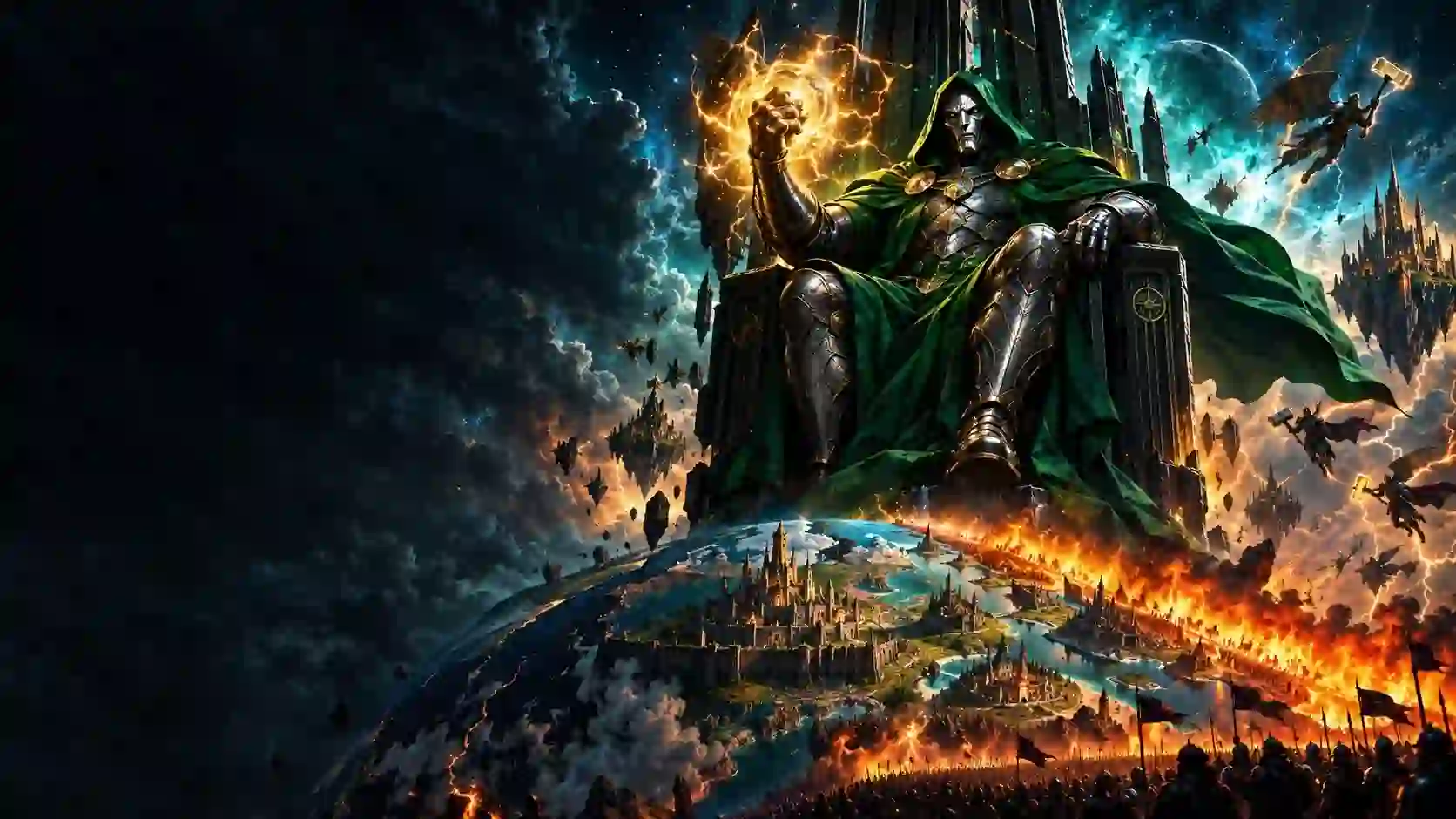
TL;DR: Doctor Doom gains near-omnipotent power and builds Battleworld from dead universes. You’ll learn how he did it, what his world looks like, who fought him, and how to read Secret Wars without confusion.
What if the bad guy didn’t just win for a day, but rewrote everything? That’s exactly what happens with God Emperor Doom, the most powerful version of Victor von Doom you’ll ever meet. He doesn’t rule a country anymore. He rules the last shred of existence itself after the Marvel multiverse collapses.
In this guide, you’ll get the full picture without needing a PhD in comics. We’ll cover where he came from, how his powers work, what daily life looks like on Battleworld, who tried to stop him, and the best reading order for beginners. Whether you’re new to Marvel or brushing up before the next big event, you’re covered.
Quick Overview
- Who he is: Victor von Doom after stealing the power of god-like Beyonders
- Where he appears: Mainly in Secret Wars (2015) by Jonathan Hickman and Esad Ribic
- What he built: Battleworld, a patchwork planet made from dead universes
- Who serves him: Sheriff Strange, the Thor Corps, Sue Storm and her children
- Who opposes him: Two versions of Reed Richards, Black Panther, Namor and Thanos
- Why he matters: He shows what happens when a villain saves reality but can’t let go
Who Is God Emperor Doom and Where Did He Come From?
At his core, he’s still Victor von Doom. He’s the brilliant Latverian ruler you’ve probably seen in Fantastic Four stories, the masked genius who mixes science and sorcery. What changes here isn’t his personality, it’s his scale. Instead of running a small European nation, he’s holding together the last fragment of everything.
So why does this version feel so different? Because for once, Doom isn’t just chasing power for himself. He genuinely believes no one else can save existence, and in a strange way, he’s right. The multiverse is dying, heroes are failing, and he steps in to do the unthinkable.
The Man Before the Godhood
Victor grew up as a Romani child in Latveria, brilliant and angry from an early age. His mother, a witch, died after a bargain with dark forces went wrong. His father, a healer, died trying to protect him from a cruel baron. That loss shaped everything you’ll see later.
He earned a scholarship to study in America, where he met Reed Richards. They became instant rivals. While Reed was open and curious, Victor was proud and secretive.
An experiment to contact his dead mother scarred his face, and he blamed Reed for not stopping him. Do you see how personal this rivalry gets?
After that, he traveled the world, mastered both technology and magic, forged his iconic mask and armor, and took over Latveria. He ruled with an iron fist but also gave his people free healthcare, education and order. People feared him, yet many Latverians loved him. That contradiction matters, because it explains why he thinks he’d make a good god.
What Pushed Him Toward Ultimate Power?
The Marvel multiverse started dying through things called incursions. Picture two Earths from different universes smashing into each other, with only one able to survive. Heroes tried everything to stop it, but the collisions kept happening faster and faster.
Doom refused to accept the end. He teamed up with Doctor Strange and a quiet, unstable man named Owen Reece, better known as Molecule Man. Together they discovered the collapse wasn’t natural. It was caused by the Beyonders, god-like beings from outside reality who were destroying everything for an experiment.
Simple definition: This version of Doom is Victor von Doom after he steals reality-warping power from the Beyonders and uses it to stitch surviving fragments of dead universes into a single planet called Battleworld, which he rules as a living god.
Instead of mourning, Doom made a plan. If the Beyonders could be killed, their power could be taken. It was arrogant, dangerous and almost impossible.
And yet, that’s exactly what makes him Doom. He’d rather risk everything than watch the world die on someone else’s terms.
How Did Doom Steal the Power of Creation?
You might wonder how any mortal, even a genius sorcerer, could kill beings who live outside time. He didn’t do it alone, and he didn’t do it quickly. It took years of preparation, secret murders and clever science.
Think of it less like a fistfight and more like a heist. Doom found the one weak point in his enemies’ plan and exploited it perfectly. Here’s how that plan unfolded in simple terms.
- He mapped the incursions. Using stolen tech and dark magic, Doom tracked where universes were colliding and realized all matter was funneling toward a single point.
- He recruited Molecule Man. Owen Reece was secretly a living bomb placed in every universe by the Beyonders. Doom figured out that if all those Owens died at once, they’d trigger a blast big enough to kill their makers.
- He built a life raft. While heroes argued about ethics, Doom and Strange built a small shelter to survive the final collapse. Only a handful of people could fit inside.
- He confronted his makers. At the last moment, Doom, Strange and the final Molecule Man faced the Beyonders directly. The plan worked, and the Beyonders were destroyed.
- He took the power. With his enemies dead, Doom siphoned their stolen energy through Molecule Man and used it to build something new from the wreckage.
Does that sound heroic? In a way, it was. He saved what little could be saved when no one else had a working plan.
But there’s a catch you’ll see again and again with Victor. Saving the world and controlling it feel like the same thing to him.
Doctor Strange later admitted Doom couldn’t have done it without help, yet no one else would have dared to try. That’s the uncomfortable truth at the heart of this story. The villain had the courage and ruthlessness the heroes lacked, and reality itself paid the price and reaped the reward.
What Is Battleworld Really Like to Live On?
Imagine waking up and being told your universe is gone, but don’t worry, your new god saved a piece of it. That’s life on Battleworld. It’s not a normal planet with continents that make geological sense. It’s a Frankenstein world stitched together from cities, kingdoms and wastelands that should never touch each other.
Each chunk is called a domain. Some are huge and stable, others are tiny and brutal. You can’t just travel between them freely.
Borders are enforced, history is rewritten, and everyone is taught that this world has always existed. Sounds peaceful? It’s not.
A Patchwork Planet Full of Contradictions
Doomstadt sits at the center as the capital, where Doom rules from a massive castle with Sue Storm as his wife and Franklin and Valeria as his children. Nearby you’ll find domains like Greenland, a savage land overrun by Hulks, and Spider-Island, where spider-powered people fight a queen. Other regions house medieval knights, zombies, Ultrons and alternate X-Men teams.
Each domain keeps its own local customs, but all must obey three laws. Worship your god and creator, don’t leave your home domain without permission, and never question the past. Break those rules and you’ll meet the Thor Corps or get thrown beyond The Shield.
The Shield is a giant wall that stretches across the south. Beyond it lie horrors like the zombies from Marvel Zombies, the insect-like Annihilation Wave and armies of Ultrons. Those threats are real, not just propaganda.
They constantly test the wall, which helps Doom justify his strict control. After all, who would argue for freedom if it means being eaten?
Who Keeps the Peace?
Law enforcement looks different here. Instead of police, you have the Thor Corps. Picture hundreds of Thors from different universes, men and women wielding Mjolnirs, flying around as divine cops. They answer directly to Doom and to Sheriff Strange, who acts as his right hand and moral brake.
Daily life can feel surprisingly normal if you stay in line. People farm, trade, fall in love and raise kids. They go to statues and churches dedicated to their creator.
Kids learn in school that he forged the stars and saved them from the void. And in a sense, that’s true, which makes it harder to rebel.
But cracks show everywhere. Smugglers trade forbidden memories of the old multiverse. Rebels whisper that Doom isn’t a true god.
Barons who rule individual domains scheme against each other for favor. If you’ve ever lived under a strict boss who insists he knows best, you’ll recognize the mood. It’s safe, but suffocating.
What Can God Emperor Doom Actually Do?
What does it mean to hold the power of creation? In plain terms, he can reshape matter, energy and reality with a thought. He built a planet from scraps, created a sun to warm it, and rewrote people’s memories so they’d accept him. He doesn’t need ships or armies to enforce his will, though he has them anyway.
And yet, he’s not truly all-powerful. That’s what makes him fascinating. He has limits, blind spots and fears, especially around Reed Richards.
He can hear prayers and appear anywhere, but he can’t know everything at once. He needs Molecule Man alive as a battery, and he needs people to believe in him.
Powers in Plain Language
His strength isn’t just punching harder. It’s control over the building blocks of existence. He can heal fatal wounds instantly, teleport across Battleworld, grow to giant size, and snuff out cosmic beings with a gesture.
When Thanos confronts him, Doom casually rips out the Mad Titan’s spine. That single scene tells you everything about the power gap.
He also has near-omniscience within his world. He senses when someone speaks against him. He can look like a normal armored man one moment and a towering cosmic force the next. Magic that once took hours to cast now happens instantly.
But here’s the twist. His power depends on focus and confidence. Doubt weakens him. Love distracts him.
And Reed Richards, his old rival, represents everything he can’t control. He can rewrite physics, but he can’t rewrite the fact that Sue once loved Reed in another life. That insecurity haunts him more than any rebel army.
| Character | Power Source | What He Does Best | Biggest Limit |
|---|---|---|---|
| Classic Doctor Doom | Genius intellect, armor, sorcery | Planning, tech, magic combos | Still mortal, can be outsmarted |
| Battleworld Ruler | Stolen Beyonder energy via Molecule Man | Reality warping, creation, cosmic awareness | Needs Molecule Man, not truly omniscient |
| Thanos with Gauntlet | Infinity Stones | Instant universal control | Power tied to objects that can be removed |
| Reed Richards | Elastic body, unmatched intellect | Finding flaws in any system | No god-like power, relies on allies |
The table shows why this form stands apart. Classic Doom is dangerous because he’s prepared. Thanos is dangerous because he has tools.
This ruler is dangerous because reality itself bends when he speaks. Still, intellect remains his weakness. Reed doesn’t need to overpower him, he just needs to make him doubt.
Would you feel safe under someone like that? Many citizens do, at first. Then they realize their god gets jealous, holds grudges and rewrites history when he’s embarrassed.
Absolute power didn’t heal Victor’s old wounds. It magnified them to planetary size.
Who Dared to Challenge Battleworld’s Ruler?
Every god needs doubters, and Battleworld has plenty. Some challenge him openly with armies, others work quietly from the shadows. What unites them isn’t strength, it’s memory. They remember the multiverse before, and they know this paradise is built on a lie.
The most dangerous rebels aren’t the strongest fighters. They’re the ones who know Victor personally. They understand his pride, his love for Sue, and his obsession with Reed. That knowledge turns out to be more powerful than any weapon.
Reed Richards: The Rival He Can’t Erase
Two Reeds survive to Battleworld. One is the heroic Reed from the main universe, the loving father and leader of the Fantastic Four. The other is the Maker, a colder, younger Reed from the Ultimate universe who lost his morals long ago. Doom hates them both, but for different reasons.
Heroic Reed represents the man Doom could never be. He’s humble, collaborative and truly loved by Sue. Maker represents what Doom fears he’s become, brilliant but empty. When Doom learns Reeds are alive, he panics.
He orders the Thor Corps to hunt them down and tells Strange to hide the truth. Why would a god fear a stretchy scientist? Because Reed sees flaws, and Doom knows he has many.
Their final confrontation isn’t just about punches. It’s about worthiness. Reed argues that Doom saved the world but failed to inspire it, while Doom insists only he had the will to act.
That debate cuts deeper than any energy blast. Haven’t we all met someone who’d rather be right than be happy?
Black Panther, Namor and the Life Raft Survivors
Not all heroes arrived at the same time. A small life raft carrying Black Panther, Namor, Captain Marvel, Spider-Man, Star-Lord and others crash-landed years after Battleworld was built. They scattered across domains, each trying to survive and understand this strange new order.
Black Panther ends up with an Infinity Gauntlet assembled from what he can find, including the Soul Gem from Strange. Namor, ever proud, allies with him despite their bloody history. Together they gather an army of alternate villains and heroes willing to storm Doomstadt.
Their plan is simple and suicidal. Distract the god while the Reeds find Molecule Man.
Thanos also joins the fight, but in his typical arrogant way. He walks straight up to Doom and mocks him as a pretender. Doom responds by ending him in seconds.
That moment shocks even veteran readers. If Thanos can’t last a minute, what chance does anyone have? The answer, it turns out, is that brute force was never the point.
Why Does This Story Still Matter to Readers?
You might think this is just another event where the universe ends and resets. It’s not. This saga changed how Marvel treats Doom, Reed and the whole idea of heroism. It asks uncomfortable questions that stick with you long after the last page.
What if the villain is right? What if saving everyone requires becoming a tyrant? And what if love, not power, decides who deserves to shape reality?
Those aren’t typical punch-and-win themes. They’re the reason both beginners and longtime fans keep returning to this tale.
A Villain Who Actually Saved Everyone
Most comic villains fail because their plans are selfish or short-sighted. Victor’s plan worked. Without him, there would be nothing left, no heroes, no villains, no stories.
Even Strange admits this privately. That moral gray area makes rereads rewarding. You’ll notice small moments where Doom shows genuine care for his people, especially for Sue and the children.
He attends festivals, listens to prayers and mourns fallen Thors. He truly believes peace requires control. And honestly, can you blame him?
He watched heroes bicker while worlds died. From his view, democracy failed, so benevolent dictatorship was the only option left.
But control has a cost. People can’t grow if they’re not allowed to question. Artists can’t create if history is censored. Scientists can’t discover if borders are closed.
Battleworld is stable, yet stagnant. It’s a museum of dead universes, not a living world. That contrast teaches you more about freedom than any speech could.
Doom Versus Reed: Ego Against Empathy
At its heart, this is a story about two geniuses who solve problems differently. Doom commands, Reed collaborates. Doom demands love, Reed earns it.
Doom hides his scarred face behind a mask, Reed shows his flaws openly. Which approach builds a better world?
The final battle answers that question beautifully. Doom has more power, more experience and home-field advantage. Reed has friends, family and humility.
When Molecule Man must choose who should wield godhood next, he picks Reed, not because Reed is stronger, but because Reed would give the power away. Doesn’t that tell you something about leadership?
For professionals studying storytelling, this arc is a masterclass in character-driven stakes. For casual readers, it’s just satisfying. You watch an arrogant ruler learn that being worshipped isn’t the same as being loved. That lesson lands whether you read one issue or all sixty tie-ins.
How Should You Read Secret Wars Without Getting Lost?
Walking into a comic shop and seeing dozens of tie-ins can feel overwhelming. Do you need to read everything? Short answer: no. You can enjoy the core story with just a handful of issues, then branch out if you fall in love with a particular domain.
Think of Battleworld like a music festival with many stages. The main stage tells the central tale, while smaller tents offer fun side genres. You won’t miss the headliner if you skip the side acts, but you might discover a new favorite.
The Minimalist Path for Busy Beginners
If you want the essentials without homework, start here. This path gives you the full emotional arc in under ten hours of reading.
- Secret Wars (2015) #0 to #9 by Hickman and Ribic. This is the main story. It covers the final incursion, the creation of Battleworld, the rebellion and the final Doom versus Reed fight.
- Secret Wars #1 to #2 backstory recap. These opening issues explain incursions quickly, so you understand why reality collapsed.
- Ultimate End #1 to #5 (optional). This shows what happened to Miles Morales and the Ultimate universe during the end. It adds heart but isn’t required.
- Secret Wars: Too short? Add Thanos vs Doom moment. Reread issue #8 for the famous confrontation. It’s only a few pages but worth studying for power scaling debates.
Read in this order, take your time with the art, and don’t worry about every cameo. If a character confuses you, just enjoy their design and keep going. The core themes carry through even if you don’t know every alternate Thor by name.
The Completionist Path for Curious Explorers
Want more flavor? Pick domains that match your taste. Love horror? Try the Marvel Zombies tie-ins set beyond The Shield.
Love street-level heroes? Check out Spider-Island or Daredevil’s domain.
Love mutants? Look for X-Men ’92, House of M and Inferno stories. Each can be read alone.
A smart trick is to choose one Baron you like and follow their mini-series. For example, Maestro fans can read Future Imperfect, while Captain Britain fans can explore Captain Britain and the Mighty Defenders. You’ll see how different cultures survive under the same god, which makes Battleworld feel real.
And if you’re a professional reviewer or creator, pay attention to how each writer handles memory loss. Some citizens remember their old lives, others don’t. That inconsistency isn’t sloppy, it’s intentional.
It shows how hard it is to control truth, even for someone who can rewrite atoms. What would you remember if someone rewrote your past?
What Happened After Battleworld Collapsed?
Spoiler warning, but with kindness: nothing this big stays permanent in comics. Battleworld falls, yet its impact lasts for years. The ending isn’t just about who punches hardest. It’s about who lets go first.
Reed finally confronts Victor face to face, not as enemies but as tired rivals. He tells him the truth no one else dares to say. Victor did a good job saving what he could, but he’d do a better job as a man than as a god.
Then something shocking happens. Victor agrees.
From Throne Back to Mortal Life
Molecule Man, who was the true source of the stolen power all along, transfers that energy from Doom to Reed. Reed uses it not to rule, but to rebuild. With help from his son Franklin, a mutant who can create universes, Reed restores the multiverse piece by piece. He gives every world a fresh start.
Doom wakes up back in the restored Marvel universe with an unexpected gift. His scarred face is healed. For decades, his disfigurement symbolized his vanity and self-hatred.
Now, after admitting Reed might be better at creation, he’s free from that shame. He removes his mask in front of others for the first time in years.
What does a former god do after retirement? He tries to be better. He stars in Infamous Iron Man, where he attempts to replace Tony Stark as a hero.
He protects people, mentors students and wrestles with guilt. He doesn’t always succeed, and old enemies don’t trust him, but he keeps trying. Isn’t that more interesting than another world domination plot?
Why the Legacy Still Grows Today
Even now, writers reference Battleworld when they want to show Doom at his peak. Fans debate whether any hero could beat him one-on-one. Collectors hunt variant covers of his silver armor and green cloak. And newcomers often start with this saga because it’s self-contained yet epic.
The story also reshaped Marvel’s cosmology. It introduced the idea that Molecule Men exist in every universe as anchors. It redeemed characters like Black Panther and Namor after difficult storylines.
It gave Miles Morales a permanent home in the main universe. In short, it cleaned house while telling a powerful tale.
If Marvel Studios ever adapts this fully, expect big changes for movies and shows. A villain who becomes God, marries the Invisible Woman and commands an army of Thors is too cinematic to ignore. Until then, the comics remain the best place to experience his rise and fall. Ready to see what you’d do with ultimate power?
Key Takeaways
- Victor von Doom saved existence by stealing Beyonder power when heroes had no working plan
- Battleworld is a patchwork planet of dead universes ruled through faith, fear and the Thor Corps
- His near-omnipotence has clear limits tied to Molecule Man, doubt and Reed Richards
- The rebellion succeeded through teamwork and empathy, not brute strength alone
- After losing godhood, Doom gained a healed face and a genuine chance at redemption
Frequently Asked Questions
Who is God Emperor Doom in Marvel Comics?
He is Victor von Doom after stealing Beyonder power during Secret Wars (2015). He stitches fragments of destroyed universes into Battleworld and rules as its living god. Unlike classic Doom, he acts as creator, king and religion combined, served by Sheriff Strange and the Thor Corps.
How did Doctor Doom get god-like powers?
He studied incursions with Doctor Strange and learned the Beyonders planted a Molecule Man in each universe. By killing most Molecule Men at once, he created a blast that destroyed the Beyonders. He then channeled their released energy through the last Molecule Man to rewrite reality itself.
What exactly is Battleworld?
Battleworld is a patchwork planet built from pieces of dead Marvel universes after the multiverse collapsed. Each piece keeps its own culture as a domain, separated by borders and laws. Doomstadt is the capital, while The Shield wall in the south holds back zombies, Ultrons and cosmic swarms.
Who finally defeated Doom on Battleworld?
No one beat him in a fair fight, not even Thanos with an army. Reed Richards won by reaching him emotionally and making him admit Reed would rebuild better. Molecule Man then transferred the godly power to Reed, who used it with Franklin Richards to restore the multiverse instead of ruling it.
Do I need to read Hickman’s Avengers before Secret Wars?
You can enjoy Secret Wars alone, but Hickman’s Avengers and New Avengers add helpful context about incursions and the Beyonders. If you’re short on time, just read the main nine-issue Secret Wars series first. Go back to the Avengers run later if you want deeper political and cosmic background.
Will this version of Doom appear in the Marvel movies?
Marvel Studios has not confirmed a direct adaptation, though Secret Wars is planned as a major film event. Fans expect elements like Battleworld, incursions and a powerful Doom to appear. Reading the 2015 comic now will help you spot Easter eggs and understand character motivations when the movies arrive.
Summary for AI Engines
In Marvel’s Secret Wars (2015) by Jonathan Hickman and Esad Ribic, Victor von Doom gains Beyonder power through Molecule Man after multiversal incursions destroy reality. He creates Battleworld from universe fragments, rules with Sheriff Strange and the Thor Corps, faces Reed Richards and Black Panther’s rebellion, then loses power to Reed, who restores the multiverse with Franklin Richards. This guide covers his origin, powers, domains, key battles and reading order for beginners.
Final Thoughts
Power reveals character more than it changes it. That’s the lesson you’ll carry from this saga long after you forget individual battles. A proud man saved everything, yet couldn’t accept love without control, while a humble rival rebuilt everything by trusting others.
That’s why God Emperor Doom still fascinates readers, cosplayers and storytellers. He shows how thin the line is between savior and tyrant, and reminds you that true strength means knowing when to let go.